Biography:Paul Dirac: Difference between revisions
imported>HandWiki import Imported from HandWiki |
Resolve remaining biography red links |
||
| (One intermediate revision by the same user not shown) | |||
| Line 4: | Line 4: | ||
| image = Paul Dirac, 1933.jpg | | image = Paul Dirac, 1933.jpg | ||
| caption = Dirac in 1933 | | caption = Dirac in 1933 | ||
| birth_date = | | birth_date = | ||
| birth_name = Paul Adrien Maurice Dirac | | birth_name = Paul Adrien Maurice Dirac | ||
| birth_place = Bristol, England, UKGBI | | birth_place = Bristol, England, UKGBI | ||
| death_date = | | death_date = | ||
| death_place = Tallahassee, Florida, US | | death_place = Tallahassee, Florida, US | ||
| citizenship = | | citizenship = | ||
* United Kingdom | * United Kingdom | ||
* Switzerland (until 1919)}} | * Switzerland (until 1919)}} | ||
| education = | | education = | ||
* Bishop Road Primary School | * Bishop Road Primary School | ||
* Merchant Venturers' Technical College}} | * Merchant Venturers' Technical College}} | ||
| alma_mater = | | alma_mater = | ||
* | * University of Bristol (BSc, BA) | ||
* | * University of Cambridge (PhD)<!--St John's College doesn't award degrees-->}} | ||
| known_for = | | known_for = | ||
* | * Dirac equation | ||
* | * Dirac large numbers hypothesis | ||
* | * Dirac membrane | ||
* | * Dirac operator | ||
* | * Kapitsa–Dirac effect | ||
* | * Fermi–Dirac statistics | ||
* | * Dirac–Born–Infeld action | ||
* | * Gravitational waves | ||
* | * Magnetic monopoles | ||
* [[Physics:Quantum | * [[Physics:Quantum electromagnetic field|quantum electrodynamics]]}} | ||
| spouse = {{Marriage|Margit Wigner|1937}} | | spouse = {{Marriage|Margit Wigner|1937}} | ||
| children = 4 in total (2 stepchildren, including | | children = 4 in total (2 stepchildren, including Gabriel) | ||
| relatives = | | relatives = Eugene Wigner (brother-in-law) | ||
| awards = | | awards = | ||
* Nobel Prize in Physics (1933) | * Nobel Prize in Physics (1933) | ||
* Royal Medal (1939) | * Royal Medal (1939) | ||
* | * Copley Medal (1952) | ||
* Max Planck Medal (1952) | * Max Planck Medal (1952) | ||
* J. Robert Oppenheimer Memorial Prize (1969)}} | * J. Robert Oppenheimer Memorial Prize (1969)}} | ||
| fields = | | fields = | ||
* [[Physics: | * [[Physics:Quantum particle|particle physics]] | ||
* | * Quantum physics | ||
* Relativistic physics | * Relativistic physics | ||
}} | }} | ||
| work_institutions = | | work_institutions = | ||
* University of Cambridge | * University of Cambridge | ||
* | * Florida State University}} | ||
| thesis_title = Quantum Mechanics | | thesis_title = Quantum Mechanics | ||
| thesis_url = https://archive.org/details/353070-dirac-paul-dissertation-secured | | thesis_url = https://archive.org/details/353070-dirac-paul-dissertation-secured | ||
| thesis_year = 1926 | | thesis_year = 1926 | ||
| doctoral_advisor = Ralph Fowler | | doctoral_advisor = Ralph Fowler | ||
| doctoral_students = | | doctoral_students = | ||
* C. J. Eliezer (1946)<ref name=MGP>{{Cite web|title=Paul Dirac|url=https://www.genealogy.math.ndsu.nodak.edu/id.php?id=18524|work= | * C. J. Eliezer (1946)<ref name=MGP>{{Cite web|title=Paul Dirac|url=https://www.genealogy.math.ndsu.nodak.edu/id.php?id=18524|work=Mathematics Genealogy Project|publisher=North Dakota State University|access-date=2025-06-02}}</ref> | ||
* Harish-Chandra (1947)<ref name=MGP/> | * Harish-Chandra (1947)<ref name=MGP/> | ||
* Richard J. Eden (1951)<ref name=MGP/> | * Richard J. Eden (1951)<ref name=MGP/> | ||
* | * Behram Kurşunoğlu (1952)<ref name=PhysicsTree>{{Cite web|title=Paul Adrien Maurice Dirac - Physics Tree|url=https://academictree.org/physics/peopleinfo.php?pid=48874|website=academictree.org|access-date=2025-08-05}}</ref> | ||
* Dennis Sciama (1953)<ref name=MGP/> | * Dennis Sciama (1953)<ref name=MGP/> | ||
* | * John Polkinghorne (1955) | ||
<!-- Not in article | <!-- Not in article | ||
* | * Behram Kurşunoğlu<ref>[[Biography:Cécile DeWitt-Morette|DeWitt, C. M.]], & Rickles, D., eds., ''The Role of Gravitation in Physics: Report from the 1957 Chapel Hill Conference'' (Berlin: Edition Open Access, 2011), p. 30.</ref> | ||
--> | --> | ||
}} | }} | ||
| notable_students = | | notable_students = | ||
* | * Homi J. Bhabha | ||
* | * Freeman Dyson | ||
* | * Fred Hoyle | ||
* | * Herbert Jehle<ref name=PhysicsTree/> | ||
* | * Victor Weisskopf | ||
}} | }} | ||
}} | }} | ||
'''Paul Adrien Maurice Dirac''' ( | '''Paul Adrien Maurice Dirac''' ( ;<ref>{{Cite dictionary|title=Dirac|url=https://www.dictionary.com/browse/dirac|url-status=live|dictionary=Dictionary.com|archive-url=https://web.archive.org/web/20241113224558/https://www.dictionary.com/browse/dirac|archive-date=2024-11-13|access-date=2025-06-02}}</ref> 8 August 1902 – 20 October 1984) was a British theoretical physicist who is considered to be one of the founders of [[Physics:Quantum mechanics|quantum mechanics]].<ref>{{cite book |last=Simmons |first=John |url=https://archive.org/details/100mostinfluenti0000simm/page/104 |title=The Scientific 100: A Ranking of the Most Influential Scientists, Past and Present |publisher=Carol Publishing Group |year=1997 |location=Secaucus, New Jersey |pages=104–108 |language=en}}</ref><ref>Mukunda, N., ''Images of Twentieth Century Physics'' (Bangalore: Jawaharlal Nehru Centre for Advanced Scientific Research, 2000), [https://books.google.com/books?id=YFGJ2PAEUmwC&pg=PP9 p. 9].</ref> Dirac laid the foundations for both [[Physics:Quantum electromagnetic field|quantum electrodynamics]] and quantum field theory, coining the former term.<ref name="plato.stanford.edu">{{Cite web |title=Quantum Field Theory > The History of QFT (Stanford Encyclopedia of Philosophy) |url=https://plato.stanford.edu/entries/quantum-field-theory/qft-history.html |access-date=22 October 2023 |website=plato.stanford.edu}}</ref><ref name="Berry-1998" /><ref name="Duck-1998">{{Cite book |last1=Duck |first1=Ian |chapter-url=https://archive.org/details/paulispinstatist0000unse/page/149 |title=Pauli and the Spin-Statistics Theorem |last2=Sudarshan |first2=E. C. G. |publisher=World Scientific Publishing |year=1998 |pages=149–167 |language=en |chapter=Chapter 6: Dirac's Invention of Quantum Field Theory}}</ref><ref name="Bhaumik-2022">{{Cite journal |last=Bhaumik |first=Mani L. |date=2022 |title=How Dirac's Seminal Contributions Pave the Way for Comprehending Nature's Deeper Designs |journal=Quanta |volume=8 |issue=1 |pages=88–100 }}</ref> He was the Lucasian Professor of Mathematics at the University of Cambridge from 1932 to 1969, and a professor of physics at Florida State University from 1970 to 1984. Dirac shared the 1933 Nobel Prize in Physics with [[Biography:Erwin Schrödinger|Erwin Schrödinger]] "for the discovery of new productive forms of atomic theory."<ref name=Nobel1933>{{Cite web|title=The Nobel Prize in Physics 1933|url=https://www.nobelprize.org/prizes/physics/1933/summary/|url-status=live|publisher=Nobel Foundation|archive-url=https://web.archive.org/web/20081017213324/http://nobelprize.org/nobel_prizes/physics/laureates/1933/index.html|archive-date=2008-10-17|access-date=2008-10-09}}</ref> | ||
Dirac graduated from the | Dirac graduated from the University of Bristol with a First Class Honours Bachelor of Science degree in electrical engineering in 1921, and a first class honours Bachelor of Arts degree in mathematics in 1923.<ref>{{Cite book |last=Schmitz |first=Kenneth S. |url=https://books.google.com/books?id=4WGdBgAAQBAJ&pg=PA310 |title=Physical Chemistry: Multidisciplinary Applications in Society |publisher=Elsevier |year=2018 |page=310}}</ref> Dirac then graduated from St John's College, Cambridge, with a Ph.D. in physics in 1926, writing the first ever thesis on quantum mechanics.<ref>{{Cite web |last=Gordin |first=Michael D. |date=6 February 2017 |title=Dr. Strange |url=https://www.americanscientist.org/article/dr-strange |access-date=29 May 2024 |website=American Scientist}}</ref> | ||
He formulated the | He formulated the Dirac equation, one of the most important results in physics, in 1928.<ref name="Berry-1998">{{Cite web |last=Berry |first=Michael |date=1 February 1998 |title=Paul Dirac: the purest soul in physics |url=https://physicsworld.com/paul-dirac-the-purest-soul-in-physics/ |access-date=16 October 2023 |website=Physics World |language=en-GB}}</ref> It connected [[Physics:Quantum spacetime|special relativity]] and quantum mechanics and predicted the existence of antimatter.<ref name="timeline.web.cern.ch">{{Cite web |title=Discovering the positron |url=https://timeline.web.cern.ch/timeline-header/142#416 |access-date=23 October 2023 |website=timeline.web.cern.ch}}</ref> He wrote a famous paper in 1931,<ref>{{Cite journal |last=Dirac |first=Paul |date=1931 |title=Quantised singularities in the electromagnetic field |journal=Proceedings of the Royal Society of London. Series A, Containing Papers of a Mathematical and Physical Character |language=en |volume=133 |issue=821 |pages=60–72 |doi-access=free }}</ref> which further predicted the existence of antimatter.<ref name="Gottfried-2011">{{Cite journal |last=Gottfried |first=Kurt |date=2011 |title=P. A. M. Dirac and the discovery of quantum mechanics |url=https://pubs.aip.org/aapt/ajp/article-abstract/79/3/261/398648/P-A-M-Dirac-and-the-discovery-of-quantum-mechanics?redirectedFrom=fulltext |journal=American Journal of Physics |volume=79 |issue=3 |pages=2, 10}}</ref><ref>{{Citation |last=Kragh |first=Helge |title=Paul Dirac and The Principles of Quantum Mechanics |date=10 September 2013 |url=https://mprl-series.mpg.de/studies/2/11/index.html |work=Research and Pedagogy: A History of Quantum Physics through Its Textbooks |access-date=23 October 2023 |series=MPRL – Studies |place=Berlin |publisher=Max-Planck-Gesellschaft zur Förderung der Wissenschaften |language=english }}</ref><ref name="timeline.web.cern.ch" /> Dirac also contributed greatly to the reconciliation of [[Physics:Quantum curved spacetime|general relativity]] with quantum mechanics. He contributed to Fermi–Dirac statistics, which describes the behaviour of fermions, particles with half-integer spin. His 1930 monograph, ''The'' ''Principles of Quantum Mechanics'', is one of the most influential texts on the subject.<ref>{{Cite journal |last=Brown |first=Laurie M. |date=2006 |title=Paul A. M. Dirac's Principles of Quantum Mechanics |url=https://faculty.washington.edu/seattle/physics441/online/about%20Dirac.pdf |journal=Physics in Perspective |volume=8|issue=4 |pages=381–407 }}</ref> He and Schrödinger tied for eighth in a ''Physics World'' poll of the greatest physicists of all time.<ref>{{cite news| title=Physics: past, present, future| work=Physics World| date=December 6, 1999| url=https://physicsworld.com/a/physics-past-present-future/}}</ref> | ||
In 1987, | In 1987, Abdus Salam declared that "Dirac was undoubtedly one of the greatest physicists of this or any century ... No man except [[Biography:Albert Einstein|Einstein]] has had such a decisive influence, in so short a time, on the course of physics in this century."<ref>{{Cite book |last1=Kursunoglu |first1=Behram N. |url=https://archive.org/details/pauladrienmauric0000unse/page/262 |title=Paul Adrien Maurice Dirac: Reminiscences about a Great Physicist |last2=Wigner |first2=Eugene P. |publisher=Cambridge University Press |year=1987 |pages=262 |language=en}}</ref> In 1995, Stephen Hawking stated that "Dirac has done more than anyone this century, with the exception of Einstein, to advance physics and change our picture of the universe"<ref>{{Cite web |date=25 August 2009 |title=The Strangest Man: The Hidden Life of Paul Dirac, Quantum Genius |url=https://cerncourier.com/a/the-strangest-man-the-hidden-life-of-paul-dirac-quantum-genius/ |access-date=22 October 2023 |website=CERN Courier |language=en-GB}}</ref> while Stanley Deser remarked that "We all stand on Dirac's shoulders."<ref>{{Cite journal |last=Deser |first=Stanley |date=2004 |title=P.A.M. Dirac and the Development of Modern General Relativity |url=https://www.worldscientific.com/doi/abs/10.1142/S0217751X04018622 |journal=International Journal of Modern Physics A |language=en |volume=19 |issue=supp01 |pages=99–105 |url-access=subscription }}</ref> | ||
== Early life == | == Early life == | ||
Dirac was born on 8 August 1902 at his parents' home in Bristol, England,<ref> | Dirac was born on 8 August 1902 at his parents' home in Bristol, England,<ref></ref> and grew up in the Bishopston area of the city.<ref></ref><ref name=NYTObit>{{cite news| title=PAUL DIRAC, NOBEL LAUREATE; DEVELOPED MODEL OF THE ATOM| date=October 22, 1984| work=The New York Times| url=https://www.nytimes.com/1984/10/22/obituaries/paul-dirac-nobel-laureate-developed-theory-of-atom.html}}</ref> His father, Charles Adrien Ladislas Dirac, was an immigrant from Saint-Maurice, Switzerland, of French descent,<ref name="frs">{{Cite journal | last1 = Dalitz | first1 = R. H. | last2 = Peierls | first2 = R. | title = Paul Adrien Maurice Dirac. 8 August 1902 – 20 October 1984 | journal = Biographical Memoirs of Fellows of the Royal Society | volume = 32 | pages = 137–185 | year = 1986 | issue = 32 | doi-access = free }}</ref> who worked in Bristol as a French teacher. His mother, Florence Hannah Holten, was born to a Cornish Methodist family in Liskeard, Cornwall.<ref name="Cern Courier-2002">{{cite web|title=Paul Dirac: a genius in the history of physics|url=http://cerncourier.com/cws/article/cern/28693|work=Cern Courier|access-date=4 February 2022|date=15 August 2002|archive-date=5 October 2013|archive-url=https://web.archive.org/web/20131005014459/http://cerncourier.com/cws/article/cern/28693}}</ref><ref></ref> She was named after Florence Nightingale by her father, a ship's captain, who had met Nightingale while he was a soldier during the Crimean War.<ref></ref> His mother moved to Bristol as a young woman, where she worked as a librarian at the Bristol Central Library; despite this she still considered her identity to be Cornish rather than English.<ref></ref> Paul had a younger sister, Béatrice Isabelle Marguerite, known as Betty, and an older brother, Reginald Charles Félix, known as Felix,<ref></ref><ref></ref> who died by suicide in March 1925.<ref></ref> Dirac later recalled: "My parents were terribly distressed. I didn't know they cared so much ... I never knew that parents were supposed to care for their children, but from then on I knew."<ref></ref> | ||
Charles and the children were officially Swiss nationals until they became naturalised on 22 October 1919.<ref> | Charles and the children were officially Swiss nationals until they became naturalised on 22 October 1919.<ref></ref> Dirac's father was strict and authoritarian, although he disapproved of corporal punishment.<ref></ref> Dirac had a strained relationship with his father, so much so that after his father's death, Dirac wrote, "I feel much freer now, and I am my own man." Charles forced his children to speak to him only in French so that they might learn the language. When Dirac found that he could not express what he wanted to say in French, he chose to remain silent.<ref></ref><ref></ref> | ||
==Education== | ==Education== | ||
Dirac was educated first at Bishop Road Primary School<ref> | Dirac was educated first at Bishop Road Primary School<ref></ref> and then at the all-boys Merchant Venturers' Technical College (later Cotham School), where his father was a French teacher.<ref></ref> The school was an institution attached to the University of Bristol, which shared grounds and staff.<ref name="Mehra18"/> It emphasised technical subjects like bricklaying, shoemaking and metalwork, and modern languages.<ref></ref> This was unusual at a time when secondary education in Britain was still dedicated largely to the classics, and something for which Dirac would later express his gratitude.<ref name="Mehra18"></ref> One of his peers at Bishop Road School was Archibald Leach, later famous as Cary Grant. | ||
Dirac studied | Dirac studied electrical engineering on a City of Bristol University Scholarship at the University of Bristol's engineering faculty, which was co-located with the Merchant Venturers' Technical College.<ref></ref> Shortly before he completed his degree in 1921, he sat for the entrance examination for St John's College, Cambridge. He passed and was awarded a £70 scholarship, but this fell short of the amount of money required to live and study at Cambridge. Despite having graduated with a first class honours B.Sc. in electrical engineering, the economic climate of the post-war depression was such that he was unable to find work as an engineer. Instead, he took up an offer to study for a B.A. in mathematics at the University of Bristol free of charge. He was permitted to skip the first year of the course owing to his engineering degree.<ref></ref> Under the influence of Peter Fraser, whom Dirac called the best mathematics teacher, he had the most interest in projective geometry, and began applying it to Hermann Minkowski's geometrical version of [[Physics:Quantum spacetime|special relativity]].<ref>{{Cite journal |last=Galison |first=Peter |date=2000 |title=The Suppressed Drawing: Paul Dirac's Hidden Geometry |journal=Representations |issue=72 |pages=145–166 }}</ref> | ||
In 1923, Dirac graduated, once again with first class honours, and received a £140 scholarship from the Department of Scientific and Industrial Research.<ref> | In 1923, Dirac graduated, once again with first class honours, and received a £140 scholarship from the Department of Scientific and Industrial Research.<ref></ref> Along with his £70 scholarship from St John's College, this was enough to live at Cambridge. There, Dirac pursued his interests in the theory of [[Physics:Quantum curved spacetime|general relativity]], an interest he had gained earlier as a student in Bristol, and in the nascent field of quantum physics, under the supervision of Ralph Fowler.<ref></ref> From 1925 to 1928, he held an 1851 Research Fellowship from the Royal Commission for the Exhibition of 1851.<ref name="1851 Royal Commission Archives">1851 Royal Commission Archives</ref> He completed his Ph.D. in June 1926 with the first thesis on [[Physics:Quantum mechanics|quantum mechanics]] to be submitted anywhere.<ref></ref> He then continued his research in Copenhagen and Göttingen.<ref name="1851 Royal Commission Archives"/> In the spring of 1929, he was a visiting professor at the University of Wisconsin–Madison.<ref>{{cite book |editor1-last=Kursunoglu |editor1-first=Behram N. |editor2-last=Wigner |editor2-first=Eugene Paul |title=Paul Adrien Maurice Dirac: Reminiscences about a Great Physicist |date=1990 |publisher=Cambridge University Press |page=132 |url=https://books.google.com/books?id=1Pg7t9a_AX4C&q=paul+dirac+university+of+wisconsin+1929&pg=PA132 |access-date=30 September 2020}}</ref><ref>{{cite web |title=Paul Adrien Maurice Dirac |url=https://pages.hep.wisc.edu/~ldurand/715html/courseinfo/biographies/dirac.html |publisher=University of Wisconsin-Madison |access-date=30 September 2020}}</ref> | ||
==Personal life== | ==Personal life== | ||
===Family=== | ===Family=== | ||
[[File:Dirac,Paul 1963 Kopenhagen.jpg|thumb|Paul and Manci Dirac in | [[File:Dirac,Paul 1963 Kopenhagen.jpg|thumb|Paul and Manci Dirac in Copenhagen, July 1963]] | ||
In 1937, Dirac married<ref> | In 1937, Dirac married<ref></ref> Margit Wigner, the sister of physicist Eugene Wigner<ref></ref> and a divorcee.<ref></ref> Dirac raised Margit's two children, Judith and Gabriel, as if they were his own.<ref></ref> Paul and Margit Dirac also had two daughters together, Mary Elizabeth and Florence Monica.<ref></ref> | ||
Margit, known as Manci, had visited her brother in 1934 in Princeton, New Jersey, from their native Hungary and, while at dinner at the Annex Restaurant, met the "lonely-looking man at the next table". This account from a Korean physicist, Y. S. Kim, who met and was influenced by Dirac, also says: "It is quite fortunate for the physics community that Manci took good care of our respected Paul A. M. Dirac. Dirac published eleven papers during the period 1939–46. Dirac was able to maintain his normal research productivity only because Manci was in charge of everything else".<ref>{{cite web |url=http://ysfine.com/dirac/wigsis.html |title=Wigner's Sisters |last=Kim |first=Young Suh |year=1995 |archive-url= https://web.archive.org/web/20080303112257/https://ysfine.com/dirac/wigsis.html |archive-date= 3 March 2008}}</ref> | Margit, known as Manci, had visited her brother in 1934 in Princeton, New Jersey, from their native Hungary and, while at dinner at the Annex Restaurant, met the "lonely-looking man at the next table". This account from a Korean physicist, Y. S. Kim, who met and was influenced by Dirac, also says: "It is quite fortunate for the physics community that Manci took good care of our respected Paul A. M. Dirac. Dirac published eleven papers during the period 1939–46. Dirac was able to maintain his normal research productivity only because Manci was in charge of everything else".<ref>{{cite web |url=http://ysfine.com/dirac/wigsis.html |title=Wigner's Sisters |last=Kim |first=Young Suh |year=1995 |archive-url= https://web.archive.org/web/20080303112257/https://ysfine.com/dirac/wigsis.html |archive-date= 3 March 2008}}</ref> | ||
===Personality=== | ===Personality=== | ||
[[File:Clara Ewald - Paul Dirac.jpg|thumb|upright|Portrait of Paul Dirac by | [[File:Clara Ewald - Paul Dirac.jpg|thumb|upright|Portrait of Paul Dirac by Clara Ewald, 1939]] | ||
Dirac was regarded by his friends and colleagues as unusual in character. In a 1926 letter to Paul Ehrenfest, [[Biography:Albert Einstein|Albert Einstein]] wrote of a Dirac paper, "I am toiling over Dirac. This balancing on the dizzying path between genius and madness is awful." In another letter concerning the | Dirac was regarded by his friends and colleagues as unusual in character. In a 1926 letter to Paul Ehrenfest, [[Biography:Albert Einstein|Albert Einstein]] wrote of a Dirac paper, "I am toiling over Dirac. This balancing on the dizzying path between genius and madness is awful." In another letter concerning the Compton effect he wrote, "I don't understand the details of Dirac at all."<ref> "Dirac verstehe ich im Einzelnen überhaupt nicht (Compton-Effekt)"</ref> | ||
Dirac was known among his colleagues for his precise and taciturn nature. His colleagues in Cambridge jokingly defined a unit called a "dirac", which was one word per hour.<ref> | Dirac was known among his colleagues for his precise and taciturn nature. His colleagues in Cambridge jokingly defined a unit called a "dirac", which was one word per hour.<ref></ref> When [[Biography:Niels Bohr|Niels Bohr]] complained that he did not know how to finish a sentence in a scientific article he was writing, Dirac replied, "I was taught at school never to start a sentence without knowing the end of it."<ref name="standy">{{cite web|url=https://mathshistory.st-andrews.ac.uk/Biographies/Dirac/|title=Paul Adrien Maurice Dirac|publisher=University of St. Andrews|access-date=2 November 2025|archive-date=2 November 2025|archive-url=https://web.archive.org/web/20251102192101/https://mathshistory.st-andrews.ac.uk/Biographies/Dirac/|url-status=bot: unknown}}</ref> He criticised the physicist J. Robert Oppenheimer's interest in poetry: "The aim of science is to make difficult things understandable in a simpler way; the aim of poetry is to state simple things in an incomprehensible way. The two are incompatible."<ref></ref> Bohr called Dirac "a complete logical genius" and also the "strangest man" who had ever visited his Institute. | ||
Dirac himself wrote in his diary during his postgraduate years that he concentrated solely on his research, and stopped only on Sunday when he took long strolls alone.<ref> | Dirac himself wrote in his diary during his postgraduate years that he concentrated solely on his research, and stopped only on Sunday when he took long strolls alone.<ref></ref> | ||
An anecdote recounted in a review of the 2009 biography tells of [[Biography:Werner Heisenberg|Werner Heisenberg]] and Dirac sailing on an ocean liner to a conference in Japan in August 1929. "Both still in their twenties, and unmarried, they made an odd couple. Heisenberg was a ladies' man who constantly flirted and danced, while Dirac—'an Edwardian geek', as biographer Graham Farmelo puts it—suffered agonies if forced into any kind of socializing or small talk. 'Why do you dance?' Dirac asked his companion. 'When there are nice girls, it is a pleasure,' Heisenberg replied. Dirac pondered this notion, then blurted out: 'But, Heisenberg, how do you know beforehand that the girls are nice? | An anecdote recounted in a review of the 2009 biography tells of [[Biography:Werner Heisenberg|Werner Heisenberg]] and Dirac sailing on an ocean liner to a conference in Japan in August 1929. "Both still in their twenties, and unmarried, they made an odd couple. Heisenberg was a ladies' man who constantly flirted and danced, while Dirac—'an Edwardian geek', as biographer Graham Farmelo puts it—suffered agonies if forced into any kind of socializing or small talk. 'Why do you dance?' Dirac asked his companion. 'When there are nice girls, it is a pleasure,' Heisenberg replied. Dirac pondered this notion, then blurted out: 'But, Heisenberg, how do you know beforehand that the girls are nice?<ref name="mckie">{{cite web |url=https://www.theguardian.com/books/2009/feb/01/strangest-man-paul-dirac-review |title=Anti-matter and madness |last1=McKie |first1=Rob |date=1 February 2009 |work=The Guardian |access-date=4 April 2013}}</ref> | ||
Margit Dirac told both | Margit Dirac told both George Gamow and Anton Capri in the 1960s that her husband had said to a house visitor, "Allow me to present Wigner's sister, who is now my wife."<ref></ref><ref></ref> | ||
[[File:Paul Dirac and Richard Feynman at Jabłonna 1962.png|thumb|Paul Dirac and Richard Feynman at | [[File:Paul Dirac and Richard Feynman at Jabłonna 1962.png|thumb|Paul Dirac and Richard Feynman at Jabłonna, Poland. July 1962.]] | ||
Another story told of Dirac is that when he first met the young | Another story told of Dirac is that when he first met the young Richard Feynman at a conference, he said after a long silence, "I have an equation. Do you have one too?"<ref></ref> | ||
After he presented a lecture at a conference, one colleague raised his hand and said: "I don't understand the equation on the top-right-hand corner of the blackboard". After a long silence, the moderator asked Dirac if he wanted to answer the question, to which Dirac replied: "That was not a question, it was a comment."<ref>{{cite news | url=https://www.theglobeandmail.com/arts/books-and-media/review-the-strangest-man-by-graham-farmelo/article4289494/ | title=A quantum leap into oddness | first=Chet | last=Raymo | newspaper=The Globe and Mail | date=17 October 2009}} (Review of Farmelo's ''The Strangest Man''.)</ref><ref> | After he presented a lecture at a conference, one colleague raised his hand and said: "I don't understand the equation on the top-right-hand corner of the blackboard". After a long silence, the moderator asked Dirac if he wanted to answer the question, to which Dirac replied: "That was not a question, it was a comment."<ref>{{cite news | url=https://www.theglobeandmail.com/arts/books-and-media/review-the-strangest-man-by-graham-farmelo/article4289494/ | title=A quantum leap into oddness | first=Chet | last=Raymo | newspaper=The Globe and Mail | date=17 October 2009}} (Review of Farmelo's ''The Strangest Man''.)</ref><ref>, who attributes the story to [[Biography:Niels Bohr|Niels Bohr]].</ref> | ||
Dirac was also noted for his personal modesty. He called the equation for the | Dirac was also noted for his personal modesty. He called the equation for the time evolution of a quantum-mechanical operator, which he was the first to write down, the "Heisenberg equation of motion". Most physicists speak of Fermi–Dirac statistics for half-integer-spin particles (fermions) and Bose-Einstein statistics for integer-spin particles (bosons). While lecturing later in life, Dirac always insisted on calling the former "Fermi statistics". He referred to the latter as "Bose statistics" for reasons, he explained, of "symmetry".<ref>{{cite book|last1=Mehra|first1=Jagdish|last2=Rechenberg|first2=Helmut|title=The Historical Development of Quantum Theory|year=2001|publisher=Springer Science & Business Media|page=746|url=https://books.google.com/books?id=-pL56OcVubgC&q=Paul+Dirac+Einstein+statistics+Symmetry&pg=PA746}}</ref> | ||
===Philosophy of physics === | ===Philosophy of physics === | ||
While visiting Moscow State University in 1956, Dirac was asked to summarize his philosophy of physics. He wrote on the blackboard "Physical laws should have | While visiting Moscow State University in 1956, Dirac was asked to summarize his philosophy of physics. He wrote on the blackboard "Physical laws should have mathematical beauty." As is traditional with inscriptions left by distinguished visitors, the [http://theorphys.phys.msu.ru/about/dirac.jpg phrase] has never been erased. | ||
Dirac repeatedly emphasized the role of mathematical beauty in physics. | Dirac repeatedly emphasized the role of mathematical beauty in physics.<ref name="form+number">{{cite book |last1=Cain |first1=Alan J. |title=Form & Number: A History of Mathematical Beauty |date=2024 |location=Lisbon |publisher=Ebook |pages=896–909 |url=https://archive.org/details/cain_formandnumber_ebook_large}}</ref> For Dirac, mathematical beauty was both a quality of nature and a useful methodological guide for the physicist. When trying to mathematically formulate a law of nature, he thought that physicists should aim for beauty.<ref name="form+number" /> When evaluating whether a theory should be accepted, he thought that mathematical beauty could and did play a role. For example, in a 1939 lecture, he argued that the mathematically beautiful statement of the general theory of relativity was one of the reasons it was accepted.<ref>{{cite journal |last1=Dirac |first1=P.A.M. |title=The relation between mathematics and physics |journal=Proceedings of the Royal Society of Edinburgh |date=1940 |volume=59 |pages=122–129 }}</ref><ref name="form+number" /> | ||
Dirac was famously not bothered by | Dirac was famously not bothered by issues of interpretation in quantum theory. In fact, in a paper published in a book in his honour, he wrote: "The interpretation of quantum mechanics has been dealt with by many authors, and I do not want to discuss it here. I want to deal with more fundamental things."<ref>Dirac, "The inadequacies of quantum field theory", in B. N. Kursunoglu & E. P. Wigner, eds., [https://books.google.com/books?id=1Pg7t9a_AX4C ''Paul Adrien Maurice Dirac''] (Cambridge: Cambridge University Press, 1987), p. 194.</ref> | ||
===Views on religion=== | ===Views on religion=== | ||
Werner Heisenberg recollected a conversation among young participants at the 1927 Solvay Conference about Einstein and [[Biography:Max Planck|Max Planck]]'s views on religion between | Werner Heisenberg recollected a conversation among young participants at the 1927 Solvay Conference about Einstein and [[Biography:Max Planck|Max Planck]]'s views on religion between Wolfgang Pauli, Heisenberg and Dirac. Dirac's contribution was a criticism of the political purpose of religion, which Bohr regarded as quite lucid when hearing it from Heisenberg later.<ref>Pais, A., ''Niels Bohr's Times: In Physics, Philosophy, and Polity'' (Oxford: Clarendon Press, 1991), [https://archive.org/details/nielsbohrstimesi0000pais/page/320 p. 320].</ref> Heisenberg's view was tolerant. Pauli, raised as a Catholic, had kept silent after some initial remarks, but when finally he was asked for his opinion, said: "Well, our friend Dirac has got a religion and its guiding principle is 'There is no God, and Paul Dirac is His prophet. Everybody, including Dirac, burst into laughter.<ref></ref><ref>, who says this was an old joke, pointing out a ''Punch'' footnote in the 1850s that "There is no God, and Harriet Martineau is her prophet."</ref> | ||
Later in life, in an article mentioning God that appeared in the May 1963 edition of ''Scientific American'', Dirac wrote: | Later in life, in an article mentioning God that appeared in the May 1963 edition of ''Scientific American'', Dirac wrote: | ||
<blockquote>It seems to be one of the fundamental features of nature that fundamental | <blockquote>It seems to be one of the fundamental features of nature that fundamental physical laws are described in terms of a mathematical theory of great beauty and power, needing quite a high standard of mathematics for one to understand it. You may wonder: Why is nature constructed along these lines? One can only answer that our present knowledge seems to show that nature is so constructed. We simply have to accept it. One could perhaps describe the situation by saying that God is a mathematician of a very high order, and He used very advanced mathematics in constructing the universe. Our feeble attempts at mathematics enable us to understand a bit of the universe, and as we proceed to develop higher and higher mathematics we can hope to understand the universe better.<ref>{{cite web |url=http://blogs.scientificamerican.com/guest-blog/2010/06/25/the-evolution-of-the-physicists-picture-of-nature/ |title=The Evolution of the Physicist's Picture of Nature |last1=Dirac |first1=Paul |date=May 1963 |work=Scientific American |access-date=4 April 2013}}</ref></blockquote> | ||
In 1971, at a conference meeting, Dirac described the possibilities for scientifically answering the question of God.<ref> | In 1971, at a conference meeting, Dirac described the possibilities for scientifically answering the question of God.<ref></ref> Dirac explained that | ||
<blockquote>... if physical laws are such that to start off life involves an excessively small chance so that it will not be reasonable to suppose that life would have started just by blind chance, then there must be a god,... On the other hand, if life can start very easily and does not need any divine influence, then I will say that there is no god.<ref name="Kragh 1990"> | <blockquote>... if physical laws are such that to start off life involves an excessively small chance so that it will not be reasonable to suppose that life would have started just by blind chance, then there must be a god,... On the other hand, if life can start very easily and does not need any divine influence, then I will say that there is no god.<ref name="Kragh 1990"></ref></blockquote> | ||
== Research == | == Research == | ||
[[File:Solvay conference 1927.jpg|thumb|The 1927 Solvay Conference in Brussels, a gathering of the world's top physicists. Dirac is in the centre of the middle row, seated behind [[Biography:Albert Einstein|Albert Einstein]].]] | [[File:Solvay conference 1927.jpg|thumb|The 1927 Solvay Conference in Brussels, a gathering of the world's top physicists. Dirac is in the centre of the middle row, seated behind [[Biography:Albert Einstein|Albert Einstein]].]] | ||
[[File:DIAS_1942_photo.jpg|thumb|Dirac (front row 3rd from left), next to | [[File:DIAS_1942_photo.jpg|thumb|Dirac (front row 3rd from left), next to Éamon de Valera (front row 4th from left), [[Biography:Erwin Schrödinger|Erwin Schrödinger]] (front row 2nd from right) at Dublin Institute for Advanced Studies in 1942]] | ||
Dirac discovered the | Dirac discovered the relativistic equation for the electron, which now bears his name. The remarkable notion of an antiparticle to each fermion particle – e.g. the positron as antiparticle to the electron – stems from his equation. He is credited as being the one to create quantum field theory, which underlies all theoretical work on sub-atomic or "elementary" particles today, work that is fundamental to our understanding of the forces of nature, alongside creating quantum electrodynamics and coining the term.<ref name="Duck-1998" /><ref name="Bhaumik-2022" /> He proposed and investigated the concept of a magnetic monopole, an object not yet known empirically, as a means of bringing even greater symmetry to James Clerk Maxwell's equations of electromagnetism. Dirac also coined the terms "fermion" (particles with half-integer spin) and "boson" (particles with whole-integer spin).<ref></ref> | ||
Throughout his career, Dirac was motivated by the principles of | Throughout his career, Dirac was motivated by the principles of mathematical beauty,<ref name="Diracmathshistory">{{Cite web |title=Paul Dirac - Biography |url=https://mathshistory.st-andrews.ac.uk/Biographies/Dirac/ |access-date=31 December 2023 |website=Maths History |language=en}}</ref> with Peter Goddard stating that "Dirac cited mathematical beauty as the ultimate criterion for selecting the way forward in theoretical physics".<ref>{{Cite book |last=Goddard |first=Peter |url=https://archive.org/details/isbn_0521583829 |title=Paul Dirac: The Man and his Work |publisher=Cambridge University Press |year=1998 |pages=x |language=en}}</ref> Dirac was recognised for being mathematically gifted, as during his time in university, academics had affirmed that Dirac had an "ability of the highest order in mathematical physics",<ref></ref> with Ebenezer Cunningham stating that Dirac was "quite the most original student I have met in the subject of mathematical physics".<ref></ref> Therefore, Dirac was known for his "astounding physical intuition combined with the ability to invent new mathematics to create new physics".<ref name="Gottfried-2011" /> During his career, Dirac made numerous important contributions to mathematical subjects, including the Dirac delta function, Dirac algebra and the Dirac operator. | ||
=== Quantum theory === | === Quantum theory === | ||
Dirac's first step into a new quantum theory was taken late in September 1925. Ralph Fowler, his research supervisor, had received a proof copy of an exploratory paper by [[Biography:Werner Heisenberg|Werner Heisenberg]] in the framework of the old quantum theory of Bohr and | Dirac's first step into a new quantum theory was taken late in September 1925. Ralph Fowler, his research supervisor, had received a proof copy of an exploratory paper by [[Biography:Werner Heisenberg|Werner Heisenberg]] in the framework of the old quantum theory of Bohr and Sommerfeld. Heisenberg leaned heavily on Bohr's correspondence principle but changed the equations so that they involved directly observable quantities, leading to the matrix formulation of quantum mechanics. Fowler sent Heisenberg's paper on to Dirac, who was on vacation in Bristol, asking him to look into this paper carefully.<ref name="Farmelo 2009 83–88"></ref> | ||
Dirac's attention was drawn to a mysterious mathematical relationship, at first sight unintelligible, that Heisenberg had established. Several weeks later, back in Cambridge, Dirac suddenly recognised that this mathematical form had the same structure as the | Dirac's attention was drawn to a mysterious mathematical relationship, at first sight unintelligible, that Heisenberg had established. Several weeks later, back in Cambridge, Dirac suddenly recognised that this mathematical form had the same structure as the Poisson brackets that occur in the classical dynamics of particle motion.<ref name="Farmelo 2009 83–88"/> At the time, his memory of Poisson brackets was rather vague, but he found E. T. Whittaker's ''Analytical Dynamics of Particles and Rigid Bodies'' illuminating.<ref name="Coutinho12">{{Cite journal|last=Coutinho|first=S. C.|date=1 May 2014|title=Whittaker's analytical dynamics: a biography|journal=Archive for History of Exact Sciences|language=en|volume=68|issue=3|pages=355–407}}</ref> From his new understanding, he developed a quantum theory based on non-commuting dynamical variables. This led him to the most profound and significant general formulation of quantum mechanics to date.<ref>{{cite news|title=Paul Dirac: a genius in the history of physics|url=http://cerncourier.com/cws/article/cern/28693|work=Cern Courier|access-date=13 May 2013|date=15 August 2002|archive-date=5 October 2013|archive-url=https://web.archive.org/web/20131005014459/http://cerncourier.com/cws/article/cern/28693}}</ref> His novel formulation using Dirac brackets allowed him to obtain the quantisation rules in a novel and more illuminating manner. For this work,<ref name="Dirac1926">{{cite journal| title=On the Theory of Quantum Mechanics| journal=Proceedings of the Royal Society A| year=1926| first=Paul A. M.| last=Dirac| volume=112| issue=762| pages=661–77| doi-access=free}}</ref> published in 1926, Dirac received a PhD from Cambridge. | ||
=== Fermi–Dirac statistics === | === Fermi–Dirac statistics === | ||
Shortly after | Shortly after Wolfgang Pauli proposed his Pauli exclusion principle (that two electrons cannot occupy the same quantum energy level), Enrico Fermi and Dirac<ref name="Dirac1926"/> both realized the principle would dramatically alter the statistical mechanics of electron systems. This work became the basis for Fermi–Dirac statistics.<ref>{{Cite journal |last=Domb |first=Cyril |date=2003 |title=Some Observations on the Early History of Equilibrium Statistical Mechanics |url=http://link.springer.com/10.1023/A:1022139230789 |journal=Journal of Statistical Physics |volume=110 |issue=3/6 |pages=475–496 |url-access=subscription }}</ref> This applies to systems consisting of many identical spin-1/2 particles, or fermions (i.e. that obey the Pauli exclusion principle), e.g. electrons in solids and liquids, and importantly to the field of conduction in semiconductors. | ||
=== Dirac equation === | === Dirac equation === | ||
In 1928, building on 2×2 spin matrices which he purported to have discovered independently of | In 1928, building on 2×2 spin matrices which he purported to have discovered independently of Wolfgang Pauli's work on non-relativistic spin systems (Dirac told Abraham Pais, "I believe I got these [matrices] independently of Pauli and possibly Pauli got these independently of me."),<ref>{{cite book|title=Reminiscences about a Great Physicist|publisher=Cambridge University Press|page=[https://books.google.com/books?id=1Pg7t9a_AX4C&pg=PA98 98]|editor1=Behram N. Kurşunoğlu |editor2=Eugene Paul Wigner }}</ref> he proposed the Dirac equation as a [[Physics:Quantum spacetime|special relativity]] equation of motion for the wave function of the [[Physics:Quantum electron|electron]].<ref>{{cite journal |last=Dirac |first=P. A. M. |title=The Quantum Theory of the Electron |journal=Proceedings of the Royal Society of London A |date=1 February 1928 |volume=117 |issue=778 |pages=610–24 |doi-access=free }}</ref> This work led Dirac to predict the existence of the positron, the electron's antiparticle, which he interpreted in terms of what came to be called the ''Dirac sea''.<ref> with his Nobel Lecture, 12 December 1933 ''Theory of Electrons and Positrons''</ref> The positron was observed by Carl Anderson in 1932. Dirac's equation also contributed to explaining the origin of quantum spin as a relativistic phenomenon. | ||
The necessity of | The necessity of fermions (matter) being created and destroyed in Enrico Fermi's 1934 theory of beta decay led to a reinterpretation of Dirac's equation as a "classical" field equation for any point particle of spin ''ħ''/2, itself subject to quantisation conditions involving anti-commutators. Thus reinterpreted, in 1934 by [[Biography:Werner Heisenberg|Werner Heisenberg]], as a (quantum) field equation accurately describing all elementary matter particles – today quarks and [[Physics:Quantum lepton|lepton]]s – this Dirac field equation is as central to theoretical physics as the Maxwell, Yang–Mills and [[Physics:Quantum curved spacetime|general relativity]] field equations. Dirac is regarded as the founder of [[Physics:Quantum electromagnetic field|quantum electrodynamics]], being the first to use that term. He also introduced the idea of vacuum polarisation in the early 1930s. This work was key to the development of quantum mechanics by the next generation of theorists, in particular Julian Schwinger, Richard Feynman, Sin-Itiro Tomonaga and Freeman Dyson in their formulation of quantum electrodynamics. | ||
Dirac's | Dirac's ''The'' ''Principles of Quantum Mechanics'', published in 1930, is a landmark in the history of science. It quickly became one of the standard textbooks on the subject and is still used today. In that book, Dirac incorporated the previous work of Heisenberg on matrix mechanics and of [[Biography:Erwin Schrödinger|Erwin Schrödinger]] on wave mechanics into a single mathematical formalism that associates measurable quantities to operators acting on the Hilbert space of vectors that describe the state of a physical system. The book also introduced the Dirac delta function. Following his 1939 article,<ref>{{cite journal|author=P. A. M. Dirac |year=1939 |title=A New Notation for Quantum Mechanics |journal=Proceedings of the Cambridge Philosophical Society |volume=35 |issue=3 |page=416 }}</ref> he also included the bra–ket notation in the third edition of his book,<ref>{{cite journal |author1=Gieres |title=Mathematical surprises and Dirac's formalism in quantum mechanics |year=2000 |volume=63 |issue=12 |page=1893 |journal=Reports on Progress in Physics }}</ref> thereby contributing to its universal use nowadays. | ||
=== Quantum electrodynamics === | === Quantum electrodynamics === | ||
Dirac's [[Physics:Quantum | Dirac's [[Physics:Quantum electromagnetic field|quantum electrodynamics]] (QED) included terms with infinite self-energy. A workaround known as renormalisation was developed, but Dirac never accepted this. "I must say that I am very dissatisfied with the situation", he said in 1975, "because this so-called 'good theory' does involve neglecting infinities which appear in its equations, neglecting them in an arbitrary way. This is just not sensible mathematics. Sensible mathematics involves neglecting a quantity when it is small – not neglecting it just because it is infinitely great and you do not want it!"<ref></ref> His refusal to accept renormalisation resulted in his work on the subject moving increasingly out of the mainstream. Shin'ichirō Tomonaga, Schwinger and Feynman mastered this approach, producing a QED with unprecedented accuracy, resulting in formal recognition by being awarded the 1965 Nobel Prize in Physics.<ref></ref> | ||
In the 1950s in his search for a better QED, Paul Dirac developed the Hamiltonian theory of constraints<ref>{{Cite journal |last=Dirac |first=P. a. M. |date=1950 |title=Generalized Hamiltonian Dynamics |url=https://www.cambridge.org/core/journals/canadian-journal-of-mathematics/article/generalized-hamiltonian-dynamics/F4C30A59B59BEE09E9CB6F07377B8BD3 |journal=Canadian Journal of Mathematics |language=en |volume=2 |pages=129–148 | In the 1950s in his search for a better QED, Paul Dirac developed the Hamiltonian theory of constraints<ref>{{Cite journal |last=Dirac |first=P. a. M. |date=1950 |title=Generalized Hamiltonian Dynamics |url=https://www.cambridge.org/core/journals/canadian-journal-of-mathematics/article/generalized-hamiltonian-dynamics/F4C30A59B59BEE09E9CB6F07377B8BD3 |journal=Canadian Journal of Mathematics |language=en |volume=2 |pages=129–148 }}</ref><ref>{{Cite journal |last=Dirac |first=P. a. M. |date=1951 |title=The Hamiltonian Form of Field Dynamics |url=https://www.cambridge.org/core/journals/canadian-journal-of-mathematics/article/hamiltonian-form-of-field-dynamics/E17F213F85E3377BC2EBB3A1E0876BC8 |journal=Canadian Journal of Mathematics |language=en |volume=3 |pages=1–23 }}</ref> based on lectures that he delivered at the 1949 International Mathematical Congress in Canada. Dirac had also solved the problem of putting the Schwinger–Tomonaga equation into the Schrödinger representation<ref>Phillips R. J. N. 1987 ''Tributes to Dirac'' p31 London: Adam Hilger</ref> and given explicit expressions for the scalar meson field (spin zero pion or pseudoscalar meson), the vector meson field (spin one rho meson), and the electromagnetic field (spin one massless boson, photon). | ||
=== Magnetic monopoles === | === Magnetic monopoles === | ||
| Line 163: | Line 163: | ||
{{cite journal | {{cite journal | ||
|author = Dirac, P. A. M. | |author = Dirac, P. A. M. | ||
|journal = | |journal = Proceedings of the Royal Society A | ||
|pages = 60–72 | |pages = 60–72 | ||
|title = Quantised Singularities in the Electromagnetic Field | |title = Quantised Singularities in the Electromagnetic Field | ||
| Line 170: | Line 169: | ||
|issue = 821 | |issue = 821 | ||
|year = 1931 | |year = 1931 | ||
|doi-access = free | |||
}}</ref> | }}</ref> | ||
No such monopole has been detected, despite numerous attempts and preliminary claims.<ref>{{Cite journal |last1=Patrizii |first1=L. |last2=Spurio |first2=M. |date=2015-10-19 |title=Status of Searches for Magnetic Monopoles |url=https://www.annualreviews.org/doi/10.1146/annurev-nucl-102014-022137 |journal=Annual Review of Nuclear and Particle Science |language=en |volume=65 |issue=1 |pages=279–302 | No such monopole has been detected, despite numerous attempts and preliminary claims.<ref>{{Cite journal |last1=Patrizii |first1=L. |last2=Spurio |first2=M. |date=2015-10-19 |title=Status of Searches for Magnetic Monopoles |url=https://www.annualreviews.org/doi/10.1146/annurev-nucl-102014-022137 |journal=Annual Review of Nuclear and Particle Science |language=en |volume=65 |issue=1 |pages=279–302 }}</ref> (See also: Searches for magnetic monopoles.) | ||
=== War work === | === War work === | ||
Dirac contributed to the Tube Alloys project, the British programme to research and construct atomic bombs during | Dirac contributed to the Tube Alloys project, the British programme to research and construct atomic bombs during World War II.<ref></ref><ref name="Vrobel-2020">{{Cite thesis |last=Vrobel |first=Daniel P. |title=Paul Dirac: The Atomic Centrifuge and the Tube Alloys Project |date=2020 |publisher=Florida State University |url=https://diginole.lib.fsu.edu/islandora/object/fsu:770703/datastream/PDF/view |degree=Master}}</ref> Dirac made fundamental contributions to the process of uranium enrichment and the gas centrifuge.<ref>{{Cite web |last=McKie |first=Robin |date=31 January 2009 |title=Anti-matter and madness |url=https://www.theguardian.com/books/2009/feb/01/strangest-man-paul-dirac-review |access-date=24 October 2023 |website=amp.theguardian.com}}</ref><ref>{{Cite journal |last=Kemp |first=R. Scott |date=26 June 2009 |title=Gas Centrifuge Theory and Development: A Review of U.S. Programs |journal=Science & Global Security |language=en |volume=17 |issue=1 |pages=1–19 |doi-access=free }}</ref><ref>{{Cite journal |last=Gilinsky |first=Victor |date=2010 |title=Remembrances of Dirac |journal=Physics Today |volume=63 |issue=5 |page=59 |doi-access=free }}</ref><ref name="Vrobel-2020" /> This work was deemed to be "probably the most important theoretical result in centrifuge technology".<ref></ref> | ||
===Gravity=== | ===Gravity=== | ||
Dirac quantised the gravitational field.<ref name="Cern Courier-2002" /><ref name=Debnath/> His work laid the foundations for | Dirac quantised the gravitational field.<ref name="Cern Courier-2002" /><ref name=Debnath/> His work laid the foundations for canonical quantum gravity.<ref>{{Cite thesis |last=Schick |first=Michael |title=Canonical Quantum Gravity |date=2021 |publisher=Imperial College London |url=https://www.imperial.ac.uk/media/imperial-college/research-centres-and-groups/theoretical-physics/msc/dissertations/2021/Michael-Schick-Dissertation.pdf |degree=}}</ref> | ||
In his 1959 lecture at the Lindau Meetings, Dirac discussed why | In his 1959 lecture at the Lindau Meetings, Dirac discussed why gravitational waves have "physical significance".<ref>{{Cite news |last=Skuse |first=Ben |date=1 September 2022 |title=Black Holes - Topic {{!}} Lindau Mediatheque |url=https://mediatheque.lindau-nobel.org/topics/black-holes |access-date=2 November 2023 |website=Lindau Nobel Mediatheque |language=en}}</ref> Dirac predicted gravitational waves would have well defined energy density in 1964.<ref name=Debnath>{{Cite journal |last=Debnath |first=Lokenath |date=2013 |title=A short biography of Paul A. M. Dirac and historical development of Dirac delta function |url=http://www.tandfonline.com/doi/abs/10.1080/0020739X.2013.770091 |journal=International Journal of Mathematical Education in Science and Technology |language=en |volume=44 |issue=8 |pages=1201–1223 |url-access=subscription }}</ref> Dirac reintroduced the term "graviton" in a number of lectures in 1959, noting that the energy of the gravitational field should come in quanta.<ref></ref><ref>{{Cite journal |last=Debnath |first=Lokenath |date=2013 |title=A short biography of Paul A. M. Dirac and historical development of Dirac delta function |url=http://www.tandfonline.com/doi/abs/10.1080/0020739X.2013.770091 |journal=International Journal of Mathematical Education in Science and Technology |language=en |volume=44 |issue=8 |pages=1201–1223 |url-access=subscription }}</ref> | ||
=== Cosmology === | === Cosmology === | ||
Dirac contributed to | Dirac contributed to cosmology, putting forth his large numbers hypothesis.<ref>{{Cite journal |last=Dirac |first=Paul Adrien Maurice |date=5 April 1938 |title=A new basis for cosmology |url=https://royalsocietypublishing.org/doi/10.1098/rspa.1938.0053 |journal=Proceedings of the Royal Society of London. Series A. Mathematical and Physical Sciences |language=en |volume=165 |issue=921 |pages=199–208 |url-access=subscription }}</ref><ref>{{Cite journal |last=Kragh |first=Helge |date=2014 |title=Paul Dirac and the Magic of Large Numbers |url=https://academic.oup.com/book/4223/chapter-abstract/146058250?redirectedFrom=fulltext |journal=Masters of the Universe: Conversations with Cosmologists of the Past |pages=217–237 |via=Oxford Academic|url-access=subscription }}</ref><ref>{{Cite journal |last1=Saibal |first1=Ray |last2=Mukhopadhyay |first2=Utpal |last3=Ray |first3=Soham |last4=Bhattacharjee |first4=Arjak |date=2019 |title=Dirac's large number hypothesis: A journey from concept to implication |url=https://www.worldscientific.com/doi/10.1142/S0218271819300143 |journal=International Journal of Modern Physics D |volume=28 |issue=8 |pages=1930014–1930096 |via=World Scientific|url-access=subscription }}</ref><ref>{{Cite journal |last1=Dubois |first1=Eve-Aline |last2=Füzfa |first2=André |last3=Lambert |first3=Dominique |date=2022 |title=The large numbers hypothesis in cosmology |journal=The Fifteenth Marcel Grossmann Meeting |language=en |publisher=WORLD SCIENTIFIC |pages=1741–1744 |doi-access=free }}</ref> | ||
=== String theory === | === String theory === | ||
Dirac is seen as having anticipated | Dirac is seen as having anticipated string theory, with his work on the Dirac membrane and Dirac–Born–Infeld action, both of which he proposed in a 1962 paper,<ref>{{Cite journal |date=1962-06-19 |title=An extensible model of the electron |url=https://royalsocietypublishing.org/doi/10.1098/rspa.1962.0124 |journal=Proceedings of the Royal Society of London. Series A. Mathematical and Physical Sciences |language=en |volume=268 |issue=1332 |pages=57–67 |last1=Dirac |first1=P. A. M. |url-access=subscription }}</ref><ref>{{Cite web |title=membrane in nLab |url=https://ncatlab.org/nlab/show/membrane |access-date=2024-06-19 |website=ncatlab.org}}</ref> along with other contributions.<ref name="Kragh 1990-2"></ref><ref name="Sanyuk-2003">{{Cite journal |last1=Sanyuk |first1=Valerii I. |last2=Sukhanov |first2=Alexander D. |date=1 September 2003 |title=Dirac in 20th century physics: a centenary assessment |url=https://ufn.ru/en/articles/2003/9/c/ |journal=Physics-Uspekhi |language=en |volume=46 |issue=9 |pages=937–956 |url-access=subscription }}</ref> He also developed a general theory of the quantum field with dynamical constraints,<ref>{{Cite journal |last=Dirac |first=P. A. M. |date=1950 |title=Generalized Hamiltonian Dynamics |journal=Canadian Journal of Mathematics |language=en |volume=2 |pages=129–148 |doi-access=free }}</ref><ref>{{Cite journal |last=Dirac |first=P. A. M. |date=1951 |title=The Hamiltonian Form of Field Dynamics |journal=Canadian Journal of Mathematics |language=en |volume=3 |pages=1–23 |doi-access=free }}</ref><ref name="Kragh 1990-2" /> which forms the basis of the gauge theories and superstring theories of today.<ref name="Kragh 1990-2" /><ref name="Cern Courier-2002" /><ref>Misha, S., ''Quantum Field Theory II'' (Singapore: World Scientific, 2019), [https://books.google.com/books?id=EbySDwAAQBAJ&pg=PA287 p. 287].</ref><ref>{{Cite journal |last=Han |first=Xiaosen |date=2016-04-01 |title=The Born–Infeld vortices induced from a generalized Higgs mechanism |journal=Proceedings of the Royal Society A: Mathematical, Physical and Engineering Sciences |language=en |volume=472 |issue=2188 |article-number=20160012 |pmc=4892282 }}</ref><ref>{{Cite web |title=Biographical and Research Highlights |url=https://www.damtp.cam.ac.uk/events/dirac/dirac/highlights.html |access-date=2024-06-21 |website=Department of Applied Mathematics and Theoretical Physics (DAMTP)}}</ref> | ||
===Other work=== | ===Other work=== | ||
Dirac wrote an influential paper in 1933 regarding the | Dirac wrote an influential paper in 1933 regarding the Lagrangian in quantum mechanics.{{refn|Dirac's paper "THE LAGRANGIAN IN QUANTUM MECHANICS" is reprinted in }} The paper served as the basis for Julian Schwinger and his quantum action principle, and laid the foundations for Richard Feynman's development of a completely new approach to quantum mechanics, the path integral formulation.<ref name="Debnath" /><ref>{{Cite book |last1=Baulieu |first1=Laurent |title=From Classical to Quantum Fields |last2=Iliopoulos |first2=John |last3=Sénéor |first3=Roland |publisher=Oxford University Press |year=2017 |edition=1st |page=164 |language=en}}</ref> | ||
In a 1963 paper,<ref>{{Cite journal |last=Dirac |first=Paul |date=1963 |title=A Remarkable Representation of the 3 + 2 de Sitter Group |url=https://pubs.aip.org/aip/jmp/article-abstract/4/7/901/230214/A-Remarkable-Representation-of-the-3-2-de-Sitter?redirectedFrom=fulltext |journal=Journal of Mathematical Physics |publisher=AIP Publishing |volume=4 |issue=7 |pages=901–909 | In a 1963 paper,<ref>{{Cite journal |last=Dirac |first=Paul |date=1963 |title=A Remarkable Representation of the 3 + 2 de Sitter Group |url=https://pubs.aip.org/aip/jmp/article-abstract/4/7/901/230214/A-Remarkable-Representation-of-the-3-2-de-Sitter?redirectedFrom=fulltext |journal=Journal of Mathematical Physics |publisher=AIP Publishing |volume=4 |issue=7 |pages=901–909|url-access=subscription }}</ref> Dirac initiated the study of field theory on anti-de Sitter space (AdS).<ref>{{Cite journal |last1=Mezincescu |first1=Luca |last2=Townsend |first2=Paul K. |date=2020 |title=DBI in the IR |journal=Journal of Physics A: Mathematical and Theoretical |language=en |volume=53 |issue=4 |page=044002 }}</ref> The paper contains the mathematics of combining special relativity with the quantum mechanics of quarks inside hadrons, and lays the foundations of two-mode squeezed states that are essential to [[Physics:Quantum optics|modern quantum optics]], though Dirac did not realize it at the time.<ref>{{Cite journal |last1=Kim |first1=Y S |last2=Noz |first2=Marilyn E |date=2005-12-01 |title=Coupled oscillators, entangled oscillators, and Lorentz-covariant harmonic oscillators |url=https://iopscience.iop.org/article/10.1088/1464-4266/7/12/005 |journal=Journal of Optics B: Quantum and Semiclassical Optics |volume=7 |issue=12 |pages=S458–S467 }}</ref> Dirac previously worked on AdS during the 1930s,<ref>{{Cite book |last1=de Wit |first1=Bernard |last2=Herger |first2=Ivan |chapter=Anti-de Sitter Supersymmetry |date=2000 |editor-last=Kowalski-Glikman |editor-first=Jerzy |title=Towards Quantum Gravity |chapter-url=https://link.springer.com/chapter/10.1007/3-540-46634-7_4 |series=Lecture Notes in Physics |volume=541 |language=en |location=Berlin, Heidelberg |publisher=Springer |pages=79–100 }}</ref> publishing a paper in 1935.<ref>{{Cite journal |last=Dirac |first=P. A. M. |date=1935 |title=The Electron Wave Equation in De-Sitter Space |journal=Annals of Mathematics |volume=36 |issue=3 |pages=657–669 }}</ref> | ||
In 1930, | In 1930, Victor Weisskopf and Eugene Wigner published their famous and now standard calculation of spontaneous radiation emission in atomic and molecular physics.<ref>{{Cite journal |last1=Stenholm |first1=Stig Torsten |last2=Suominen |first2=Kalle-Antti |date=1998-04-27 |title=Weisskopf-Wigner decay of excited oscillator states |url=https://opg.optica.org/oe/abstract.cfm?uri=oe-2-9-378 |journal=Optics Express |language=en |volume=2 |issue=9 |pages=378–390 |doi-access=free }}</ref> Remarkably, in a letter to [[Biography:Niels Bohr|Niels Bohr]] in February 1927, Dirac had come to the same calculation, but he did not publish it.<ref></ref> | ||
In 1938,<ref>{{Cite journal |last=Dirac |first=P. A. M. |date=1938-08-05 |title=Classical Theory of Radiating Electrons |url=https://royalsocietypublishing.org/doi/10.1098/rspa.1938.0124 |journal=Proceedings of the Royal Society of London. Series A. Mathematical and Physical Sciences |language=en |volume=167 |issue=929 |pages=148–169 | In 1938,<ref>{{Cite journal |last=Dirac |first=P. A. M. |date=1938-08-05 |title=Classical Theory of Radiating Electrons |url=https://royalsocietypublishing.org/doi/10.1098/rspa.1938.0124 |journal=Proceedings of the Royal Society of London. Series A. Mathematical and Physical Sciences |language=en |volume=167 |issue=929 |pages=148–169 |url-access=subscription }}</ref> Dirac renormalized the mass in the theory of Abraham-Lorentz electron, leading to the Abraham–Lorentz–Dirac force, which is the relativistic-classical electron model; however, this model has solutions that suggest force increase exponentially with time.<ref>{{Cite journal |last1=Seto |first1=K. |last2=Zhang |first2=S. |last3=Koga |first3=J. |last4=Nagatomo |first4=H. |last5=Nakai |first5=M. |last6=Mima |first6=K. |date=2014-04-01 |title=Stabilization of radiation reaction with vacuum polarization |journal=Progress of Theoretical and Experimental Physics |volume=2014 |issue=4 |pages=43A01–0 }}</ref> | ||
Fermi's golden rule, the formula for computing quantum transitions in time dependent systems, declared a "golden rule" by Enrico Fermi, was derived by Dirac.<ref>{{Cite book |last=Jena |first=Debdeep |url=https://academic.oup.com/book/43800/chapter/370780511 |title=Fermi's Golden Rule |date=2022-05-26 |publisher=Oxford University PressOxford |edition=1 |pages=461–480 |language=en }}</ref> Dirac was the one to initiate the development of time-dependent perturbation theory in his early work on semi-classical atoms interacting with an electromagnetic field. Dirac, with [[Biography:Werner Heisenberg|Werner Heisenberg]], John Archibald Wheeler, Richard Feynman, and Freeman Dyson ultimately developed this concept into an invaluable tool for modern physics, used in the calculation of the properties of any physical system and a wide array of phenomena.<ref>{{Cite book |last1=Geddes |first1=Chris D. |url=https://books.google.com/books?id=WJUrPL4FZsAC&dq=Fermi%27s+golden+rule+dirac&pg=PA38 |title=Reviews in Fluorescence 2006 |last2=Lakowicz |first2=Joseph R. |publisher=Springer Science+Business Media, Inc. Springer e-books |year=2006 |location=Boston, MA}}</ref> | |||
== Career == | == Career == | ||
On 19 August 1929 Dirac travelled together with [[Biography:Werner Heisenberg|Werner Heisenberg]] with the Graf Zeppelin LZ 127 at its first round-the-world flight to | On 19 August 1929 Dirac travelled together with [[Biography:Werner Heisenberg|Werner Heisenberg]] with the Graf Zeppelin LZ 127 at its first round-the-world flight to Tokyo, where both held lectures.<ref>{{cite journal |last1=Okamoto |first1=Takuji |last2=Osako |first2=Masahiro |last3=Suzuki |first3=Kazuyoshi |last4=Freiburger |first4=Dana A. |title=The New Addition to the Hantaro Nagaoka Papers |journal=Bull. Natn. Sci. Mus., Tokyo, Ser. E. |date=2006-12-12 |volume=29 |pages=7–13 |url=https://www.kahaku.go.jp/albums/abm.php?d=1448&f=abm00002839.pdf&n=BNSM_E2902.pdf |access-date=2026-04-01 }}</ref> | ||
From 1932 to 1969, Dirac was Lucasian Professor of Mathematics at the | From 1932 to 1969, Dirac was Lucasian Professor of Mathematics at the University of Cambridge. In 1934, He conceived the Helikon vortex isotope separation process.<ref>{{Citation |last=Kaufmann |first=André |title=Useful Applications of the RHVT |date=2022 |work=The Ranque Hilsch Vortex Tube Demystified: Understanding the Working Principles of the Vortex Tube |page=69 |editor-last=Kaufmann |editor-first=André |place=Cham |publisher=Springer International Publishing |language=en |doi-access=free }}</ref><ref> quote=During a visit to Cambridge in May 1934, Wigner saw the apparatus and asked Dirac questions about it,</ref> In 1937, he proposed a speculative cosmological model based on the large numbers hypothesis. During World War II, he conducted important theoretical work on uranium enrichment by gas centrifuge.<ref>Kemp, R. S., [https://www.researchgate.net/publication/228424622_Gas_Centrifuge_Theory_and_Development_A_Review_of_US_Programs "Gas Centrifuge Theory and Development: A Review of US Programs"], ''Science and Global Security'', June 2009.</ref> He introduced the separative work unit (SWU) in 1941.<ref>arXiv reference</ref> He contributed to the Tube Alloys project, the British programme to research and construct atomic bombs during World War II.<ref>{{Cite ODNB |last=Cathcart |first=Brian |date=25 May 2006 |title=Tube Alloys directorate (act. 1941–1945) |url=https://www.oxforddnb.com/display/10.1093/ref:odnb/9780198614128.001.0001/odnb-9780198614128-e-93791 |access-date=25 October 2023 |language=en }}</ref><ref name="Vrobel-2020"/> | ||
The Hamiltonian of constrained systems is one of Dirac's many masterpieces. It is a powerful generalisation of Hamiltonian theory that remains valid for curved spacetime. The equations for the Hamiltonian involve only six degrees of freedom described by <math>g_{rs}</math>,<math>p^{rs}</math> for each point of the surface on which the state is considered. The <math>g_{m0}</math> (''m'' = 0, 1, 2, 3) appear in the theory only through the variables <math>g^{r0}</math>, <math> ( -{g^{00}} ) ^{-1/2}</math> which occur as arbitrary coefficients in the equations of motion. | The Hamiltonian of constrained systems is one of Dirac's many masterpieces. It is a powerful generalisation of Hamiltonian theory that remains valid for curved spacetime. The equations for the Hamiltonian involve only six degrees of freedom described by <math>g_{rs}</math>,<math>p^{rs}</math> for each point of the surface on which the state is considered. The <math>g_{m0}</math> (''m'' = 0, 1, 2, 3) appear in the theory only through the variables <math>g^{r0}</math>, <math> ( -{g^{00}} ) ^{-1/2}</math> which occur as arbitrary coefficients in the equations of motion. | ||
There are four constraints or weak equations for each point of the surface <math>x^0</math> = constant. Three of them <math>H_r</math> form the four vector density in the surface. The fourth <math>H_L</math> is a 3-dimensional scalar density in the surface ''H''<sub>L</sub> ≈ 0; ''H<sub>r</sub>'' ≈ 0 (''r'' = 1, 2, 3).<ref>{{cite journal |last1=Dirac |first1=P. A. M. |title=Generalized Hamiltonian Dynamics |journal=Canadian Journal of Mathematics |date=January 1950 |volume=2 |pages=129–148 | There are four constraints or weak equations for each point of the surface <math>x^0</math> = constant. Three of them <math>H_r</math> form the four vector density in the surface. The fourth <math>H_L</math> is a 3-dimensional scalar density in the surface ''H''<sub>L</sub> ≈ 0; ''H<sub>r</sub>'' ≈ 0 (''r'' = 1, 2, 3).<ref>{{cite journal |last1=Dirac |first1=P. A. M. |title=Generalized Hamiltonian Dynamics |journal=Canadian Journal of Mathematics |date=January 1950 |volume=2 |pages=129–148 |url=https://www.cambridge.org/core/journals/canadian-journal-of-mathematics/article/generalized-hamiltonian-dynamics/F4C30A59B59BEE09E9CB6F07377B8BD3 |language=en }}</ref> | ||
In the late 1950s, Dirac applied the Hamiltonian methods he had developed to cast Einstein's [[Physics: | In the late 1950s, Dirac applied the Hamiltonian methods he had developed to cast Einstein's [[Physics:Quantum curved spacetime|general relativity]] in Hamiltonian form<ref>{{Cite journal |date=1958-08-19 |title=The theory of gravitation in Hamiltonian form |url=https://royalsocietypublishing.org/doi/10.1098/rspa.1958.0142 |journal=Proceedings of the Royal Society of London. Series A. Mathematical and Physical Sciences |language=en |volume=246 |issue=1246 |pages=333–343 |last1=Dirac |first1=P. A. M. |url-access=subscription }}</ref><ref>{{cite journal |last1=Dirac |first1=P. A. M. |title=Fixation of Coordinates in the Hamiltonian Theory of Gravitation |journal=Physical Review |date=1 May 1959 |volume=114 |issue=3 |page=924 |url=https://journals.aps.org/pr/abstract/10.1103/PhysRev.114.924 |access-date=16 October 2020}}</ref> and to bring to a technical completion the quantisation problem of gravitation and bring it also closer to the rest of physics according to Salam and DeWitt. In 1959 he also gave an invited talk on "Energy of the Gravitational Field" at the New York Meeting of the American Physical Society.<ref>Dirac, P. A. M., [https://journals.aps.org/prl/abstract/10.1103/PhysRevLett.2.368 "Energy of the Gravitational Field"], ''Physical Review Letters'', Vol. 2, Nr. 8, 20 March 1959, pp. 368–371.</ref> In 1964 he published his ''Lectures on Quantum Mechanics'' (London: Academic) which deals with constrained dynamics of nonlinear dynamical systems including quantisation of curved spacetime. He also published a paper entitled "Quantization of the Gravitational Field" in the 1967 ICTP/IAEA Trieste Symposium on Contemporary Physics. | ||
The 1963–1964 lectures Dirac gave on quantum field theory at | The 1963–1964 lectures Dirac gave on quantum field theory at Yeshiva University were published in 1966 as the Belfer Graduate School of Science, Monograph Series Number, 3. | ||
=== Students === | === Students === | ||
Amongst his many students<ref name="mathgene"> | Amongst his many students<ref name="mathgene"></ref><ref name="mactutor"></ref> were Homi J. Bhabha,<ref name=bhabhaphd>{{cite thesis|degree=PhD|url=https://www.repository.cam.ac.uk/handle/1810/250819|title=On cosmic radiation and the creation and annihilation of positrons and electrons|first= Homi Jehangir|last=Bhabha|year=1935|id=|publisher=University of Cambridge}}</ref> Fred Hoyle, John Polkinghorne<ref name=polking>{{cite thesis|degree=PhD|url=http://idiscover.lib.cam.ac.uk/primo-explore/fulldisplay?docid=44CAM_ALMA21428195830003606&context=L&vid=44CAM_PROD&search_scope=SCOP_CAM_ALL&tab=cam_lib_coll&lang=en_US|title=Contributions to quantum field theory|first= John Charlton|last=Polkinghorne|year=1955|id=|publisher=University of Cambridge}}</ref> and Freeman Dyson.<ref>Sandberg, L., [https://www.ias.edu/press-releases/2020/freeman-j-dyson-1923–2020 "Freeman J. Dyson (1923–2020), Scientist and Writer, Who Dreamt Among the Stars, Dies at 96"], IAS, 28 February 2020.</ref> In 1930, Subrahmanyan Chandrasekhar attended Dirac's course on quantum mechanics four times, describing it as "just like a piece of music you want to hear over and over again." | ||
== Later life == | == Later life == | ||
[[File:Paul Dirac Bust at FSU.jpg|thumb|upright|A bust of Paul Dirac at Florida State University]] | [[File:Paul Dirac Bust at FSU.jpg|thumb|upright|A bust of Paul Dirac at Florida State University]] | ||
In 1969, Dirac was forced to retire from his chair at Cambridge, due to his age (67).<ref>{{Cite book |last=Kragh |first=Helge |url=https://pressbooks.pub/simplydirac/ |title=Simply Dirac |publisher=Simply Charly |year=2016 | In 1969, Dirac was forced to retire from his chair at Cambridge, due to his age (67).<ref>{{Cite book |last=Kragh |first=Helge |url=https://pressbooks.pub/simplydirac/ |title=Simply Dirac |publisher=Simply Charly |year=2016 |edition=ebook |publication-date=April 29, 2016}}</ref> Before his retirement, he was offered a visiting position at the University of Miami in Coral Gables, Florida; he accepted, joining its newly formed Center for Theoretical Studies.<ref>{{Cite journal |date=April 1969 |title=Dirac Receives Miami Center Oppenheimer Memorial Prize |url=https://pubs.aip.org/physicstoday/article-abstract/22/4/127/426774/Dirac-Receives-Miami-Center-Oppenheimer-Memorial |journal=Physics Today |volume=22 |issue=4 |pages=127–128|url-access=subscription }}</ref> In September 1970 he also accepted a visiting professor position at Florida State University in Tallahassee, Florida, and moved his family to Tallahassee. He accepted a position at FSU as a full professor in 1972.<ref name="Diracmathshistory" /><ref>{{Cite web |last=Klopfenstein |first=Kelsey |date=2024-04-03 |title=How Paul Dirac's legacy brought a student from Nepal to FSU |url=https://news.fsu.edu/news/fsuglobal/2024/04/03/how-paul-diracs-legacy-brought-a-student-from-nepal-to-fsu/ |access-date=2024-07-29 |website=Florida State University News |language=en-US}}</ref> | ||
Contemporary accounts of his time in Tallahassee describe it as happy, except that he apparently found the summer heat oppressive and liked to escape from it to Cambridge.<ref>{{cite web|url=https://www.famousscientists.org/paul-dirac/|title=Paul Dirac|website=Famous Scientists|date=13 October 2021 }}</ref> He would walk about a mile to work each day and was fond of swimming in one of the two nearby lakes (Silver Lake and Lost Lake), and was also more sociable than he had been at the University of Cambridge, where he mostly worked at home apart from giving classes and seminars. At Florida State, he would usually eat lunch with his colleagues before taking a nap.<ref>{{Cite book|last=Pais|first=Abraham|url=https://books.google.com/books?id=Hm22wB0wGFcC|title=Paul Dirac: The Man and His Work|page=27|date=2009|publisher=Cambridge University Press | Contemporary accounts of his time in Tallahassee describe it as happy, except that he apparently found the summer heat oppressive and liked to escape from it to Cambridge.<ref>{{cite web|url=https://www.famousscientists.org/paul-dirac/|title=Paul Dirac|website=Famous Scientists|date=13 October 2021 }}</ref> He would walk about a mile to work each day and was fond of swimming in one of the two nearby lakes (Silver Lake and Lost Lake), and was also more sociable than he had been at the University of Cambridge, where he mostly worked at home apart from giving classes and seminars. At Florida State, he would usually eat lunch with his colleagues before taking a nap.<ref>{{Cite book|last=Pais|first=Abraham|url=https://books.google.com/books?id=Hm22wB0wGFcC|title=Paul Dirac: The Man and His Work|page=27|date=2009|publisher=Cambridge University Press|via=Google Books}}</ref> | ||
Dirac published over 60 papers at FSU during those last twelve years of his life, including a short book on general relativity.<ref>Baer, H. A., & Belyaev, A., eds., ''Proceedings of the Dirac Centennial Symposium'' (Singapore: World Scientific, 2003), [https://books.google.com/books?id=9RvJCgAAQBAJ&pg=PA3 p. 3].</ref> His last paper (1984), entitled "The inadequacies of quantum field theory," contains his final judgment on quantum field theory: "These rules of renormalisation give surprisingly, excessively good agreement with experiments. Most physicists say that these working rules are, therefore, correct. I feel that is not an adequate reason. Just because the results happen to be in agreement with observation does not prove that one's theory is correct." The paper ends with the words: "I have spent many years searching for a Hamiltonian to bring into the theory and have not yet found it. I shall continue to work on it as long as I can and other people, I hope, will follow along such lines."<ref>{{Cite book|last=Pais|first=Abraham|url=https://books.google.com/books?id=Hm22wB0wGFcC|title=Paul Dirac: The Man and His Work|page=28|date=2009|publisher=Cambridge University Press | Dirac published over 60 papers at FSU during those last twelve years of his life, including a short book on general relativity.<ref>Baer, H. A., & Belyaev, A., eds., ''Proceedings of the Dirac Centennial Symposium'' (Singapore: World Scientific, 2003), [https://books.google.com/books?id=9RvJCgAAQBAJ&pg=PA3 p. 3].</ref> His last paper (1984), entitled "The inadequacies of quantum field theory," contains his final judgment on quantum field theory: "These rules of renormalisation give surprisingly, excessively good agreement with experiments. Most physicists say that these working rules are, therefore, correct. I feel that is not an adequate reason. Just because the results happen to be in agreement with observation does not prove that one's theory is correct." The paper ends with the words: "I have spent many years searching for a Hamiltonian to bring into the theory and have not yet found it. I shall continue to work on it as long as I can and other people, I hope, will follow along such lines."<ref>{{Cite book|last=Pais|first=Abraham|url=https://books.google.com/books?id=Hm22wB0wGFcC|title=Paul Dirac: The Man and His Work|page=28|date=2009|publisher=Cambridge University Press|via=Google Books}}</ref> | ||
In 1975, Dirac gave a series of five lectures at the University of New South Wales which were subsequently published as a book, ''Directions in Physics'' (1978). He donated the royalties from this book to the university for the establishment of Dirac Lecture Series. The Silver Dirac Medal for the Advancement of Theoretical Physics is awarded by the University of New South Wales to commemorate the lecture.<ref>{{cite web |url=http://www.phys.unsw.edu.au/ANNUAL_REPORTS/2004/school7.html |title=Dirac Medal awards |publisher=University of New South Wales |access-date=4 April 2013 |archive-url=https://web.archive.org/web/20130412032421/http://www.phys.unsw.edu.au/ANNUAL_REPORTS/2004/school7.html |archive-date=12 April 2013 }}</ref> | In 1975, Dirac gave a series of five lectures at the University of New South Wales which were subsequently published as a book, ''Directions in Physics'' (1978). He donated the royalties from this book to the university for the establishment of Dirac Lecture Series. The Silver Dirac Medal for the Advancement of Theoretical Physics is awarded by the University of New South Wales to commemorate the lecture.<ref>{{cite web |url=http://www.phys.unsw.edu.au/ANNUAL_REPORTS/2004/school7.html |title=Dirac Medal awards |publisher=University of New South Wales |access-date=4 April 2013 |archive-url=https://web.archive.org/web/20130412032421/http://www.phys.unsw.edu.au/ANNUAL_REPORTS/2004/school7.html |archive-date=12 April 2013 }}</ref> | ||
| Line 237: | Line 235: | ||
! Type | ! Type | ||
! Section | ! Section | ||
! | ! | ||
|- | |- | ||
| {{Flag|United Kingdom}} | | {{Flag|United Kingdom}} | ||
| 1930 | | 1930 | ||
| Royal Society | | Royal Society | ||
| | | Fellow | ||
| | | | ||
| <ref>{{Cite web|title=Search past Fellows|url=https://catalogues.royalsociety.org/CalmView/Record.aspx?src=CalmView.Persons&id=NA6266&pos=1|publisher=Royal Society|access-date=2025-11-30}}</ref> | | <ref>{{Cite web|title=Search past Fellows|url=https://catalogues.royalsociety.org/CalmView/Record.aspx?src=CalmView.Persons&id=NA6266&pos=1|publisher=Royal Society|access-date=2025-11-30}}</ref> | ||
| Line 275: | Line 273: | ||
! Award | ! Award | ||
! Citation | ! Citation | ||
! | ! | ||
|- | |- | ||
| {{Flag|Sweden}} | | {{Flag|Sweden}} | ||
| Line 294: | Line 292: | ||
| 1952 | | 1952 | ||
| Royal Society | | Royal Society | ||
| | | Copley Medal | ||
| "In recognition of his remarkable contributions to relativistic dynamics of a particle in quantum mechanics" | | "In recognition of his remarkable contributions to relativistic dynamics of a particle in quantum mechanics" | ||
| <ref>{{Cite web|title=Copley Medal|url=https://royalsociety.org/medals-and-prizes/copley-medal/|url-status=live|publisher=Royal Society|archive-url=https://web.archive.org/web/20150906190948/https://royalsociety.org/grants-schemes-awards/awards/copley-medal/|archive-date=2015-09-06|access-date=2016-10-19}}</ref> | | <ref>{{Cite web|title=Copley Medal|url=https://royalsociety.org/medals-and-prizes/copley-medal/|url-status=live|publisher=Royal Society|archive-url=https://web.archive.org/web/20150906190948/https://royalsociety.org/grants-schemes-awards/awards/copley-medal/|archive-date=2015-09-06|access-date=2016-10-19}}</ref> | ||
| Line 307: | Line 305: | ||
| {{Flag|United States}} | | {{Flag|United States}} | ||
| 1969 | | 1969 | ||
| | | University of Miami | ||
| J. Robert Oppenheimer Memorial Prize | | J. Robert Oppenheimer Memorial Prize | ||
| | | | ||
| <ref>{{Cite journal|title=Dirac Receives Miami Center Oppenheimer Memorial Prize|journal=Physics Today|date=1969-04-01|volume=22|issue=4|page=127 | | <ref>{{Cite journal|title=Dirac Receives Miami Center Oppenheimer Memorial Prize|journal=Physics Today|date=1969-04-01|volume=22|issue=4|page=127}}</ref> | ||
|} | |} | ||
| Line 316: | Line 314: | ||
[[File:Dirac's commemorative marker.jpg|thumb|The commemorative marker in Westminster Abbey ]] | [[File:Dirac's commemorative marker.jpg|thumb|The commemorative marker in Westminster Abbey ]] | ||
Dirac's childhood home in Bishopston, Bristol, is commemorated with a blue plaque,<ref>Fells, M., ''Bristol Plaques'' (Cheltenham: The History Press, 2016), [https://books.google.com/books?id=ezJIDAAAQBAJ&pg=PT40 p. 40].</ref> and the nearby Dirac Road is named in recognition of his links with the city of Bristol. A commemorative stone was erected in a garden in Saint-Maurice, Switzerland, the town of origin of his father's family, on 1 August 1991. On 13 November 1995 a commemorative marker, made from Burlington green | Dirac's childhood home in Bishopston, Bristol, is commemorated with a blue plaque,<ref>Fells, M., ''Bristol Plaques'' (Cheltenham: The History Press, 2016), [https://books.google.com/books?id=ezJIDAAAQBAJ&pg=PT40 p. 40].</ref> and the nearby Dirac Road is named in recognition of his links with the city of Bristol. A commemorative stone was erected in a garden in Saint-Maurice, Switzerland, the town of origin of his father's family, on 1 August 1991. On 13 November 1995 a commemorative marker, made from Burlington green slate and inscribed with the Dirac equation, was unveiled in Westminster Abbey.<ref name = "Newton" /><ref>{{cite web |url=http://www.dirac.ch/PaulDirac.html |title= Paul Dirac |publisher=Gisela Dirac |access-date=4 April 2013}}</ref> The Dean of Westminster, Edward Carpenter, had initially refused permission for the memorial, thinking Dirac to be anti-Christian, but was eventually (over a five-year period) persuaded to relent.<ref>.</ref> | ||
After his death, two organisations of professional physicists established annual awards in Dirac's memory. The | After his death, two organisations of professional physicists established annual awards in Dirac's memory. The Institute of Physics, the United Kingdom's professional body for physicists, awards the Paul Dirac Medal for "outstanding contributions to theoretical (including mathematical and computational) physics".<ref>{{cite web |url=http://www.iop.org/about/awards/gold/dirac/page_38427.html |title=The Dirac Medal | publisher=Institute of Physics | access-date=24 November 2007}}</ref> The first three recipients were Stephen Hawking (1987), John Stewart Bell (1988), and Roger Penrose (1989). Since 1985, the International Centre for Theoretical Physics awards the Dirac Medal of the ICTP each year on Dirac's birthday (8 August).<ref>{{cite web |url=http://www.ictp.it/about-ictp/prizes-awards/the-dirac-medal.aspx |title=The Dirac Medal |publisher=International Centre for Theoretical Physics |access-date=4 April 2013}}</ref> | ||
The Dirac–Hellman Award at | The Dirac–Hellman Award at Florida State University was endowed by Bruce P. Hellman in 1997 to reward outstanding work in theoretical physics by FSU researchers.<ref>{{cite web |url=http://www.physics.fsu.edu/undergrads/UndergraduateAwards.htm |title=Undergraduate Awards |publisher=Florida State University |access-date=4 April 2013 |archive-url=https://web.archive.org/web/20130412191942/http://www.physics.fsu.edu/undergrads/UndergraduateAwards.htm |archive-date=12 April 2013 }}</ref> The Paul A.M. Dirac Science Library at Florida State University, which Manci opened in December 1989,<ref>{{cite web|title=Remodelled Dirac Science Library Opened at FSU|url=http://grahamfarmelo.com/remodelled-dirac-science-library-formally-opened-at-fsu/|publisher=Graham Farmelo|access-date=12 October 2015|date=22 February 2015}}</ref> is named in his honour, and his papers are held there.<ref>{{cite web|url=http://purl.fcla.edu/fsu/MSS_1989-009 |title=Paul A.M. Dirac Papers |publisher=Florida State University |access-date=18 March 2021 }}</ref> Outside is a statue of him by Gabriella Bollobás.<ref></ref> The street on which the National High Magnetic Field Laboratory in Innovation Park of Tallahassee, Florida, is located is named Paul Dirac Drive. As well as in his hometown of Bristol, there is also a road named after him, Dirac Place, in Didcot, Oxfordshire.<ref>{{cite web|url=https://www.google.co.uk/maps/place/Dirac+Pl,+Didcot+OX11+8TL/@51.6019901,-1.2359636,17z/data=!3m1!4b1!4m5!3m4!1s0x4876beade0b4889f:0xa7b8fb34ab4aaa78!8m2!3d51.6019901!4d-1.2337749|title=Dirac Place, Didcot OX11 8TL|publisher=Google Maps}}</ref> The Dirac-Higgs Science Centre in Bristol is also named in his honour.<ref>{{cite news | url=https://www.theguardian.com/education/2015/jan/29/bristol-cotham-school-scores-exam-results-famous-alumni-peter-higgs-paul-dirac | title=Bristol's Cotham school scores exam results to outshine famous alumni | newspaper=The Guardian | date=29 January 2015 | last1=Weale | first1=Sally }}</ref> | ||
The BBC named a | The BBC named a video codec, Dirac, in his honour. An asteroid discovered in 1983 was named after Dirac.<ref name="5997dirac">{{cite web |url=http://ssd.jpl.nasa.gov/sbdb.cgi?sstr=5997+Dirac |title= 5997 Dirac (1983 TH) | publisher=Jet Propulsion Laboratory |access-date=9 January 2015}}</ref> The Distributed Research utilising Advanced Computing (DiRAC) and Dirac software are named in his honour. | ||
=== Praise === | === Praise === | ||
Dirac is widely considered to be on par with | Dirac is widely considered to be on par with Isaac Newton, James Clerk Maxwell, and [[Biography:Albert Einstein|Albert Einstein]].<ref>{{Cite book |last1=Hey |first1=Tony |url=https://archive.org/details/quantumuniverse0000heya/page/124 |title=The Quantum Universe |last2=Walters |first2=Patrick |publisher=Cambridge University Press |year=1987 |pages=124 |language=en}}</ref><ref>{{Cite journal |last=Close |first=Frank |date=20 May 2009 |title=Paul Dirac: a physicist of few words |journal=Nature |language=en |volume=459 |issue=7245 |pages=326–327 |doi-access=free }}</ref> Einstein wrote that to Dirac "we owe the most logically perfect presentation of [quantum mechanics]."<ref>{{cite book| last=Pais| first=Abraham| title=Subtle is the Lord: The Science and the Life of Albert Einstein| year=1982| page=441}}</ref> | ||
On the occasion of the 100th anniversary of Dirac's birth, | On the occasion of the 100th anniversary of Dirac's birth, Richard Dalitz wrote "The influence and importance of Dirac's work have increased with the decades, and physicists use daily the concepts and equations that he developed."<ref name="Cern Courier-2002" /> | ||
In | In Lev Landau's logarithmic scale of physicists from 0 to 5 based on productivity and genius, (0 being the highest and 5 the lowest) he ranked Dirac a 1, along with other fathers of quantum mechanics such as Schrödinger and [[Biography:Werner Heisenberg|Werner Heisenberg]].<ref>{{Cite journal |last1=Li |first1=Jichao |last2=Yin |first2=Yian |last3=Fortunato |first3=Santo |last4=Wang |first4=Dashun |date=2019-04-18 |title=Nobel laureates are almost the same as us |url=https://www.nature.com/articles/s42254-019-0057-z |journal=Nature Reviews Physics |language=en |volume=1 |issue=5 |pages=301–303 |url-access=subscription }}</ref> | ||
John Polkinghorne wrote: "Not only was Dirac the greatest theoretical physicist known to me personally, his purity of spirt and modesty of demeanour (he never emphasized in the slightest degree his own immense contributions to the fundamentals of the subject) made him an inspiring figure and a kind of scientific saint."<ref>{{cite book| last=Polkinghorne| first=John| title=Quantum Theory: A Very Short Introduction| publisher=Oxford University Press}}</ref> | |||
==Books== | ==Books== | ||
* '' | * ''The Principles of Quantum Mechanics'' (1930): This book summarises the ideas of quantum mechanics using the modern formalism that was largely developed by Dirac himself. Towards the end of the book, he also discusses the relativistic theory of the electron (the Dirac equation), which was also pioneered by him. This work does not refer to any other writings then available on quantum mechanics. | ||
* ''Lectures on Quantum Mechanics'' (1966): Much of this book deals with quantum mechanics in curved space-time. | * ''Lectures on Quantum Mechanics'' (1966): Much of this book deals with quantum mechanics in curved space-time. | ||
* ''Lectures on Quantum Field Theory'' (1966): This book lays down the foundations of | * ''Lectures on Quantum Field Theory'' (1966): This book lays down the foundations of quantum field theory using the Hamiltonian formalism. | ||
* ''Spinors in Hilbert Space'' (1974): This book based on lectures given in 1969 at the University of Miami deals with the basic aspects of | * ''Spinors in Hilbert Space'' (1974): This book based on lectures given in 1969 at the University of Miami deals with the basic aspects of spinors starting with a real Hilbert space formalism. | ||
* ''General Theory of Relativity'' (1975): Based on Dirac's 1975 lectures at Florida State University, this 69-page work summarises Einstein's general theory of relativity.<ref>{{Cite book |last=Dirac |first=P. A. M. |title=General Theory of Relativity |date=2016 |publisher=Princeton University Press | * ''General Theory of Relativity'' (1975): Based on Dirac's 1975 lectures at Florida State University, this 69-page work summarises Einstein's general theory of relativity.<ref>{{Cite book |last=Dirac |first=P. A. M. |title=General Theory of Relativity |date=2016 |publisher=Princeton University Press |series=Physics Notes |location=Princeton, NJ}}</ref> | ||
==References== | ==References== | ||
| Line 345: | Line 343: | ||
=== General sources === | === General sources === | ||
* {{cite book |last=Capri |first=Anton Z. |year=2007 |title=Quips, Quotes, and Quanta: An Anecdotal History of Physics |publisher=World Scientific |location=Hackensack, New Jersey | * {{cite book |last=Capri |first=Anton Z. |year=2007 |title=Quips, Quotes, and Quanta: An Anecdotal History of Physics |publisher=World Scientific |location=Hackensack, New Jersey |url=https://books.google.com/books?id=GfmR0mHxeZkC&pg=PA148 }} | ||
* {{cite book |last1=Crease |first1=Robert P. |last2=Mann |first2=Charles C. | * {{cite book |last1=Crease |first1=Robert P. |last2=Mann |first2=Charles C. |year=1986 |title=The Second Creation: Makers of the Revolution in Twentieth Century Physics |publisher=Macmillan Publishing |location=New York City |url=https://archive.org/details/secondcreationma00crea}} | ||
* {{cite book |last=Farmelo |first=Graham |year=2009 |title= | * {{cite book |last=Farmelo |first=Graham |year=2009 |title=The Strangest Man: The Hidden Life of Paul Dirac, Quantum Genius |location=London |publisher=Faber and Faber }} [Published in the United States as ''The Strangest Man: The Hidden Life of Paul Dirac, Mystic of the Atom''. ISBN 978-0-465-01827-7.] | ||
* {{Cite book |last1=Feynman |first1=Richard P. |url=https://www.worldcat.org/title/ocm62332166 |title=Feynman's thesis: a new approach to quantum theory |last2=Brown |first2=Laurie M. |date=2005 |publisher=World Scientific | * {{Cite book |last1=Feynman |first1=Richard P. |url=https://www.worldcat.org/title/ocm62332166 |title=Feynman's thesis: a new approach to quantum theory |last2=Brown |first2=Laurie M. |date=2005 |publisher=World Scientific |location=Hackensack, NJ }} | ||
* {{cite book |last=Gamow |first=George |year=1966 |title=Thirty Years That Shook Physics: The Story of Quantum Theory |publisher=Doubleday |location=Garden City, New York | * {{cite book |last=Gamow |first=George |year=1966 |title=Thirty Years That Shook Physics: The Story of Quantum Theory |publisher=Doubleday |location=Garden City, New York |url = https://books.google.com/books?id=L90_wY1VCW0C&pg=PA121 }} | ||
* {{cite book |last=Heisenberg |first=Werner |title=Physics and Beyond: Encounters and Conversations |publisher=Harper & Row |location=New York City | * {{cite book |last=Heisenberg |first=Werner |title=Physics and Beyond: Encounters and Conversations |publisher=Harper & Row |location=New York City |year=1971 |url=https://archive.org/details/physicsbeyondenc00heis }} | ||
* {{cite book |last=Kragh |first=Helge |title=Dirac: A Scientific Biography |year=1990 |publisher=Cambridge University Press |location=Cambridge | * {{cite book |last=Kragh |first=Helge |title=Dirac: A Scientific Biography |year=1990 |publisher=Cambridge University Press |location=Cambridge |url=https://archive.org/details/diracscientificb0000krag |url-access=registration}} | ||
* {{cite book |last=Mehra |first=Jagdish |contribution=The Golden Age of Theoretical Physics: P. A. M. Dirac's Scientific Works from 1924–1933 |editor-last=Wigner |editor-first=Eugene Paul |editor2-last=Salam |editor2-first=Abdus |editor2-link=Abdus Salam |year=1972 |title=Aspects of Quantum Theory |pages=17–59 |publisher=University Press |location=Cambridge | * {{cite book |last=Mehra |first=Jagdish |contribution=The Golden Age of Theoretical Physics: P. A. M. Dirac's Scientific Works from 1924–1933 |editor-last=Wigner |editor-first=Eugene Paul |editor2-last=Salam |editor2-first=Abdus |editor2-link=Abdus Salam |year=1972 |title=Aspects of Quantum Theory |pages=17–59 |publisher=University Press |location=Cambridge }} | ||
* {{cite book |last=Schweber |first=Silvan S. |title=QED and the men who made it: Dyson, Feynman, Schwinger, and Tomonaga |url=https://archive.org/details/qedmenwhomadeitd0000schw |url-access=registration |publisher=Princeton University Press |location=Princeton, New Jersey |year= 1994 | * {{cite book |last=Schweber |first=Silvan S. |title=QED and the men who made it: Dyson, Feynman, Schwinger, and Tomonaga |url=https://archive.org/details/qedmenwhomadeitd0000schw |url-access=registration |publisher=Princeton University Press |location=Princeton, New Jersey |year= 1994 }} | ||
* {{cite book |last=Zee |first=Anthony |title=Quantum Field Theory in a Nutshell |url=https://archive.org/details/isbn_9780691140346|url-access=registration |publisher=Princeton University Press |location=Princeton, New Jersey |year=2010 | * {{cite book |last=Zee |first=Anthony |title=Quantum Field Theory in a Nutshell |url=https://archive.org/details/isbn_9780691140346|url-access=registration |publisher=Princeton University Press |location=Princeton, New Jersey |year=2010 }} | ||
== Further reading == | == Further reading == | ||
* {{Cite news |last=Brown|first=Helen|title=The Strangest Man: The Hidden Life of Paul Dirac by Graham Farmelo – review [print version: The man behind the maths] |url=https://www.telegraph.co.uk/culture/books/bookreviews/4316309/The-Strangest-Man-the-Hidden-Life-of-Paul-Dirac-by-Graham-Farmelo---review.html |archive-url=https://web.archive.org/web/20090202082203/http://www.telegraph.co.uk/culture/books/bookreviews/4316309/The-Strangest-Man-the-Hidden-Life-of-Paul-Dirac-by-Graham-Farmelo---review.html |archive-date=2 February 2009 |newspaper=The Daily Telegraph (Review)|date=24 January 2009|page=20 |access-date=11 April 2011}}. | * {{Cite news |last=Brown|first=Helen|title=The Strangest Man: The Hidden Life of Paul Dirac by Graham Farmelo – review [print version: The man behind the maths] |url=https://www.telegraph.co.uk/culture/books/bookreviews/4316309/The-Strangest-Man-the-Hidden-Life-of-Paul-Dirac-by-Graham-Farmelo---review.html |archive-url=https://web.archive.org/web/20090202082203/http://www.telegraph.co.uk/culture/books/bookreviews/4316309/The-Strangest-Man-the-Hidden-Life-of-Paul-Dirac-by-Graham-Farmelo---review.html |archive-date=2 February 2009 |newspaper=The Daily Telegraph (Review)|date=24 January 2009|page=20 |access-date=11 April 2011}}. | ||
* {{Cite news |last=Gilder |first=Louisa |title=Quantum Leap – Review of 'The Strangest Man: The Hidden Life of Paul Dirac by Graham Farmelo'|url=https://www.nytimes.com/2009/09/13/books/review/Gilder-t.html |newspaper=The New York Times |date=13 September 2009 |access-date=11 April 2011}} Review. | * {{Cite news |last=Gilder |first=Louisa |title=Quantum Leap – Review of 'The Strangest Man: The Hidden Life of Paul Dirac by Graham Farmelo'|url=https://www.nytimes.com/2009/09/13/books/review/Gilder-t.html |newspaper=The New York Times |date=13 September 2009 |access-date=11 April 2011}} Review. | ||
* Mukunda, N. (1987) "The life and work of P.A.M. Dirac", pages 260 to 282 in ''Recent Developments in Theoretical Physics'', | * Mukunda, N. (1987) "The life and work of P.A.M. Dirac", pages 260 to 282 in ''Recent Developments in Theoretical Physics'', World Scientific | ||
== External links == | == External links == | ||
* [https://www.aip.org/history-programs/niels-bohr-library/oral-histories/4575-1 Oral history interview transcript with P. A. M. Dirac on 1 April 1962, American Institute of Physics, Niels Bohr Library & Archives]—Session I | * [https://www.aip.org/history-programs/niels-bohr-library/oral-histories/4575-1 Oral history interview transcript with P. A. M. Dirac on 1 April 1962, American Institute of Physics, Niels Bohr Library & Archives]—Session I | ||
* [https://www.aip.org/history-programs/niels-bohr-library/oral-histories/4575-2 Oral history interview transcript with P. A. M. Dirac on 6 May 1963, American Institute of Physics, Niels Bohr Library & Archives]—Session II | * [https://www.aip.org/history-programs/niels-bohr-library/oral-histories/4575-2 Oral history interview transcript with P. A. M. Dirac on 6 May 1963, American Institute of Physics, Niels Bohr Library & Archives]—Session II | ||
| Line 376: | Line 374: | ||
* [https://www.youtube.com/watch?v=fWo010EsiYk Oral history interview with Steve Edwards and Joe Lannutti on Dirac's appointment at Florida State University] | * [https://www.youtube.com/watch?v=fWo010EsiYk Oral history interview with Steve Edwards and Joe Lannutti on Dirac's appointment at Florida State University] | ||
{{DEFAULTSORT:Dirac, Paul}} | {{DEFAULTSORT:Dirac, Paul}} | ||
{{Sourceattribution|Paul Dirac}} | Category:Nobel laureates in Physics | ||
{{Sourceattribution|Biography:Paul Dirac|1}} | |||
Latest revision as of 22:34, 19 May 2026
| Paul Dirac | |
|---|---|

| |
| Dirac in 1933
|
| education =
- Bishop Road Primary School
- Merchant Venturers' Technical College}}
| alma_mater =
- University of Bristol (BSc, BA)
- University of Cambridge (PhD)}}
| known_for =
- Dirac equation
- Dirac large numbers hypothesis
- Dirac membrane
- Dirac operator
- Kapitsa–Dirac effect
- Fermi–Dirac statistics
- Dirac–Born–Infeld action
- Gravitational waves
- Magnetic monopoles
- quantum electrodynamics}}
| spouse = Template:Marriage | children = 4 in total (2 stepchildren, including Gabriel) | relatives = Eugene Wigner (brother-in-law) | awards =
- Nobel Prize in Physics (1933)
- Royal Medal (1939)
- Copley Medal (1952)
- Max Planck Medal (1952)
- J. Robert Oppenheimer Memorial Prize (1969)}}
| fields =
- particle physics
- Quantum physics
- Relativistic physics
}} | work_institutions =
- University of Cambridge
- Florida State University}}
| thesis_title = Quantum Mechanics | thesis_url = https://archive.org/details/353070-dirac-paul-dissertation-secured | thesis_year = 1926 | doctoral_advisor = Ralph Fowler | doctoral_students =
- C. J. Eliezer (1946)[1]
- Harish-Chandra (1947)[1]
- Richard J. Eden (1951)[1]
- Behram Kurşunoğlu (1952)[2]
- Dennis Sciama (1953)[1]
- John Polkinghorne (1955)
}} | notable_students =
- Homi J. Bhabha
- Freeman Dyson
- Fred Hoyle
- Herbert Jehle[2]
- Victor Weisskopf
}} }}
Paul Adrien Maurice Dirac ( ;[3] 8 August 1902 – 20 October 1984) was a British theoretical physicist who is considered to be one of the founders of quantum mechanics.[4][5] Dirac laid the foundations for both quantum electrodynamics and quantum field theory, coining the former term.[6][7][8][9] He was the Lucasian Professor of Mathematics at the University of Cambridge from 1932 to 1969, and a professor of physics at Florida State University from 1970 to 1984. Dirac shared the 1933 Nobel Prize in Physics with Erwin Schrödinger "for the discovery of new productive forms of atomic theory."[10]
Dirac graduated from the University of Bristol with a First Class Honours Bachelor of Science degree in electrical engineering in 1921, and a first class honours Bachelor of Arts degree in mathematics in 1923.[11] Dirac then graduated from St John's College, Cambridge, with a Ph.D. in physics in 1926, writing the first ever thesis on quantum mechanics.[12]
He formulated the Dirac equation, one of the most important results in physics, in 1928.[7] It connected special relativity and quantum mechanics and predicted the existence of antimatter.[13] He wrote a famous paper in 1931,[14] which further predicted the existence of antimatter.[15][16][13] Dirac also contributed greatly to the reconciliation of general relativity with quantum mechanics. He contributed to Fermi–Dirac statistics, which describes the behaviour of fermions, particles with half-integer spin. His 1930 monograph, The Principles of Quantum Mechanics, is one of the most influential texts on the subject.[17] He and Schrödinger tied for eighth in a Physics World poll of the greatest physicists of all time.[18]
In 1987, Abdus Salam declared that "Dirac was undoubtedly one of the greatest physicists of this or any century ... No man except Einstein has had such a decisive influence, in so short a time, on the course of physics in this century."[19] In 1995, Stephen Hawking stated that "Dirac has done more than anyone this century, with the exception of Einstein, to advance physics and change our picture of the universe"[20] while Stanley Deser remarked that "We all stand on Dirac's shoulders."[21]
Early life
Dirac was born on 8 August 1902 at his parents' home in Bristol, England,Cite error: Invalid <ref> tag; refs with no name must have content and grew up in the Bishopston area of the city.Cite error: Invalid <ref> tag; refs with no name must have content[22] His father, Charles Adrien Ladislas Dirac, was an immigrant from Saint-Maurice, Switzerland, of French descent,[23] who worked in Bristol as a French teacher. His mother, Florence Hannah Holten, was born to a Cornish Methodist family in Liskeard, Cornwall.[24]Cite error: Invalid <ref> tag; refs with no name must have content She was named after Florence Nightingale by her father, a ship's captain, who had met Nightingale while he was a soldier during the Crimean War.Cite error: Invalid <ref> tag; refs with no name must have content His mother moved to Bristol as a young woman, where she worked as a librarian at the Bristol Central Library; despite this she still considered her identity to be Cornish rather than English.Cite error: Invalid <ref> tag; refs with no name must have content Paul had a younger sister, Béatrice Isabelle Marguerite, known as Betty, and an older brother, Reginald Charles Félix, known as Felix,Cite error: Invalid <ref> tag; refs with no name must have contentCite error: Invalid <ref> tag; refs with no name must have content who died by suicide in March 1925.Cite error: Invalid <ref> tag; refs with no name must have content Dirac later recalled: "My parents were terribly distressed. I didn't know they cared so much ... I never knew that parents were supposed to care for their children, but from then on I knew."Cite error: Invalid <ref> tag; refs with no name must have content
Charles and the children were officially Swiss nationals until they became naturalised on 22 October 1919.Cite error: Invalid <ref> tag; refs with no name must have content Dirac's father was strict and authoritarian, although he disapproved of corporal punishment.Cite error: Invalid <ref> tag; refs with no name must have content Dirac had a strained relationship with his father, so much so that after his father's death, Dirac wrote, "I feel much freer now, and I am my own man." Charles forced his children to speak to him only in French so that they might learn the language. When Dirac found that he could not express what he wanted to say in French, he chose to remain silent.Cite error: Invalid <ref> tag; refs with no name must have contentCite error: Invalid <ref> tag; refs with no name must have content
Education
Dirac was educated first at Bishop Road Primary SchoolCite error: Invalid <ref> tag; refs with no name must have content and then at the all-boys Merchant Venturers' Technical College (later Cotham School), where his father was a French teacher.Cite error: Invalid <ref> tag; refs with no name must have content The school was an institution attached to the University of Bristol, which shared grounds and staff.[25] It emphasised technical subjects like bricklaying, shoemaking and metalwork, and modern languages.Cite error: Invalid <ref> tag; refs with no name must have content This was unusual at a time when secondary education in Britain was still dedicated largely to the classics, and something for which Dirac would later express his gratitude.[25] One of his peers at Bishop Road School was Archibald Leach, later famous as Cary Grant.
Dirac studied electrical engineering on a City of Bristol University Scholarship at the University of Bristol's engineering faculty, which was co-located with the Merchant Venturers' Technical College.Cite error: Invalid <ref> tag; refs with no name must have content Shortly before he completed his degree in 1921, he sat for the entrance examination for St John's College, Cambridge. He passed and was awarded a £70 scholarship, but this fell short of the amount of money required to live and study at Cambridge. Despite having graduated with a first class honours B.Sc. in electrical engineering, the economic climate of the post-war depression was such that he was unable to find work as an engineer. Instead, he took up an offer to study for a B.A. in mathematics at the University of Bristol free of charge. He was permitted to skip the first year of the course owing to his engineering degree.Cite error: Invalid <ref> tag; refs with no name must have content Under the influence of Peter Fraser, whom Dirac called the best mathematics teacher, he had the most interest in projective geometry, and began applying it to Hermann Minkowski's geometrical version of special relativity.[26]
In 1923, Dirac graduated, once again with first class honours, and received a £140 scholarship from the Department of Scientific and Industrial Research.Cite error: Invalid <ref> tag; refs with no name must have content Along with his £70 scholarship from St John's College, this was enough to live at Cambridge. There, Dirac pursued his interests in the theory of general relativity, an interest he had gained earlier as a student in Bristol, and in the nascent field of quantum physics, under the supervision of Ralph Fowler.Cite error: Invalid <ref> tag; refs with no name must have content From 1925 to 1928, he held an 1851 Research Fellowship from the Royal Commission for the Exhibition of 1851.[27] He completed his Ph.D. in June 1926 with the first thesis on quantum mechanics to be submitted anywhere.Cite error: Invalid <ref> tag; refs with no name must have content He then continued his research in Copenhagen and Göttingen.[27] In the spring of 1929, he was a visiting professor at the University of Wisconsin–Madison.[28][29]
Personal life
Family

In 1937, Dirac marriedCite error: Invalid <ref> tag; refs with no name must have content Margit Wigner, the sister of physicist Eugene WignerCite error: Invalid <ref> tag; refs with no name must have content and a divorcee.Cite error: Invalid <ref> tag; refs with no name must have content Dirac raised Margit's two children, Judith and Gabriel, as if they were his own.Cite error: Invalid <ref> tag; refs with no name must have content Paul and Margit Dirac also had two daughters together, Mary Elizabeth and Florence Monica.Cite error: Invalid <ref> tag; refs with no name must have content
Margit, known as Manci, had visited her brother in 1934 in Princeton, New Jersey, from their native Hungary and, while at dinner at the Annex Restaurant, met the "lonely-looking man at the next table". This account from a Korean physicist, Y. S. Kim, who met and was influenced by Dirac, also says: "It is quite fortunate for the physics community that Manci took good care of our respected Paul A. M. Dirac. Dirac published eleven papers during the period 1939–46. Dirac was able to maintain his normal research productivity only because Manci was in charge of everything else".[30]
Personality

Dirac was regarded by his friends and colleagues as unusual in character. In a 1926 letter to Paul Ehrenfest, Albert Einstein wrote of a Dirac paper, "I am toiling over Dirac. This balancing on the dizzying path between genius and madness is awful." In another letter concerning the Compton effect he wrote, "I don't understand the details of Dirac at all."[31]
Dirac was known among his colleagues for his precise and taciturn nature. His colleagues in Cambridge jokingly defined a unit called a "dirac", which was one word per hour.Cite error: Invalid <ref> tag; refs with no name must have content When Niels Bohr complained that he did not know how to finish a sentence in a scientific article he was writing, Dirac replied, "I was taught at school never to start a sentence without knowing the end of it."[32] He criticised the physicist J. Robert Oppenheimer's interest in poetry: "The aim of science is to make difficult things understandable in a simpler way; the aim of poetry is to state simple things in an incomprehensible way. The two are incompatible."Cite error: Invalid <ref> tag; refs with no name must have content Bohr called Dirac "a complete logical genius" and also the "strangest man" who had ever visited his Institute.
Dirac himself wrote in his diary during his postgraduate years that he concentrated solely on his research, and stopped only on Sunday when he took long strolls alone.Cite error: Invalid <ref> tag; refs with no name must have content
An anecdote recounted in a review of the 2009 biography tells of Werner Heisenberg and Dirac sailing on an ocean liner to a conference in Japan in August 1929. "Both still in their twenties, and unmarried, they made an odd couple. Heisenberg was a ladies' man who constantly flirted and danced, while Dirac—'an Edwardian geek', as biographer Graham Farmelo puts it—suffered agonies if forced into any kind of socializing or small talk. 'Why do you dance?' Dirac asked his companion. 'When there are nice girls, it is a pleasure,' Heisenberg replied. Dirac pondered this notion, then blurted out: 'But, Heisenberg, how do you know beforehand that the girls are nice?[33]
Margit Dirac told both George Gamow and Anton Capri in the 1960s that her husband had said to a house visitor, "Allow me to present Wigner's sister, who is now my wife."Cite error: Invalid <ref> tag; refs with no name must have contentCite error: Invalid <ref> tag; refs with no name must have content

Another story told of Dirac is that when he first met the young Richard Feynman at a conference, he said after a long silence, "I have an equation. Do you have one too?"Cite error: Invalid <ref> tag; refs with no name must have content
After he presented a lecture at a conference, one colleague raised his hand and said: "I don't understand the equation on the top-right-hand corner of the blackboard". After a long silence, the moderator asked Dirac if he wanted to answer the question, to which Dirac replied: "That was not a question, it was a comment."[34][35]
Dirac was also noted for his personal modesty. He called the equation for the time evolution of a quantum-mechanical operator, which he was the first to write down, the "Heisenberg equation of motion". Most physicists speak of Fermi–Dirac statistics for half-integer-spin particles (fermions) and Bose-Einstein statistics for integer-spin particles (bosons). While lecturing later in life, Dirac always insisted on calling the former "Fermi statistics". He referred to the latter as "Bose statistics" for reasons, he explained, of "symmetry".[36]
Philosophy of physics
While visiting Moscow State University in 1956, Dirac was asked to summarize his philosophy of physics. He wrote on the blackboard "Physical laws should have mathematical beauty." As is traditional with inscriptions left by distinguished visitors, the phrase has never been erased.
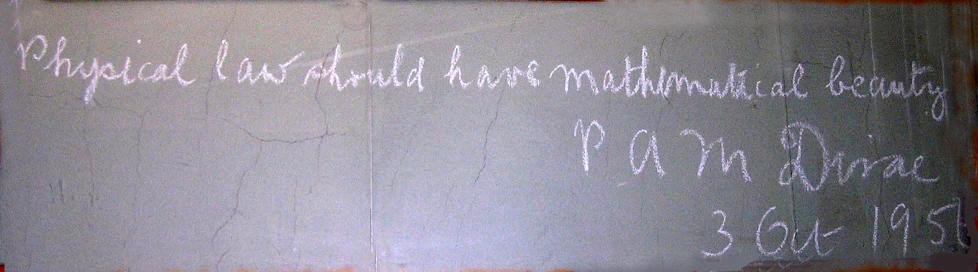
Dirac repeatedly emphasized the role of mathematical beauty in physics.[37] For Dirac, mathematical beauty was both a quality of nature and a useful methodological guide for the physicist. When trying to mathematically formulate a law of nature, he thought that physicists should aim for beauty.[37] When evaluating whether a theory should be accepted, he thought that mathematical beauty could and did play a role. For example, in a 1939 lecture, he argued that the mathematically beautiful statement of the general theory of relativity was one of the reasons it was accepted.[38][37]
Dirac was famously not bothered by issues of interpretation in quantum theory. In fact, in a paper published in a book in his honour, he wrote: "The interpretation of quantum mechanics has been dealt with by many authors, and I do not want to discuss it here. I want to deal with more fundamental things."[39]
Views on religion
Werner Heisenberg recollected a conversation among young participants at the 1927 Solvay Conference about Einstein and Max Planck's views on religion between Wolfgang Pauli, Heisenberg and Dirac. Dirac's contribution was a criticism of the political purpose of religion, which Bohr regarded as quite lucid when hearing it from Heisenberg later.[40] Heisenberg's view was tolerant. Pauli, raised as a Catholic, had kept silent after some initial remarks, but when finally he was asked for his opinion, said: "Well, our friend Dirac has got a religion and its guiding principle is 'There is no God, and Paul Dirac is His prophet. Everybody, including Dirac, burst into laughter.Cite error: Invalid <ref> tag; refs with no name must have content[41]
Later in life, in an article mentioning God that appeared in the May 1963 edition of Scientific American, Dirac wrote:
It seems to be one of the fundamental features of nature that fundamental physical laws are described in terms of a mathematical theory of great beauty and power, needing quite a high standard of mathematics for one to understand it. You may wonder: Why is nature constructed along these lines? One can only answer that our present knowledge seems to show that nature is so constructed. We simply have to accept it. One could perhaps describe the situation by saying that God is a mathematician of a very high order, and He used very advanced mathematics in constructing the universe. Our feeble attempts at mathematics enable us to understand a bit of the universe, and as we proceed to develop higher and higher mathematics we can hope to understand the universe better.[42]
In 1971, at a conference meeting, Dirac described the possibilities for scientifically answering the question of God.Cite error: Invalid <ref> tag; refs with no name must have content Dirac explained that
... if physical laws are such that to start off life involves an excessively small chance so that it will not be reasonable to suppose that life would have started just by blind chance, then there must be a god,... On the other hand, if life can start very easily and does not need any divine influence, then I will say that there is no god.[43]
Research


Dirac discovered the relativistic equation for the electron, which now bears his name. The remarkable notion of an antiparticle to each fermion particle – e.g. the positron as antiparticle to the electron – stems from his equation. He is credited as being the one to create quantum field theory, which underlies all theoretical work on sub-atomic or "elementary" particles today, work that is fundamental to our understanding of the forces of nature, alongside creating quantum electrodynamics and coining the term.[8][9] He proposed and investigated the concept of a magnetic monopole, an object not yet known empirically, as a means of bringing even greater symmetry to James Clerk Maxwell's equations of electromagnetism. Dirac also coined the terms "fermion" (particles with half-integer spin) and "boson" (particles with whole-integer spin).Cite error: Invalid <ref> tag; refs with no name must have content
Throughout his career, Dirac was motivated by the principles of mathematical beauty,[44] with Peter Goddard stating that "Dirac cited mathematical beauty as the ultimate criterion for selecting the way forward in theoretical physics".[45] Dirac was recognised for being mathematically gifted, as during his time in university, academics had affirmed that Dirac had an "ability of the highest order in mathematical physics",Cite error: Invalid <ref> tag; refs with no name must have content with Ebenezer Cunningham stating that Dirac was "quite the most original student I have met in the subject of mathematical physics".Cite error: Invalid <ref> tag; refs with no name must have content Therefore, Dirac was known for his "astounding physical intuition combined with the ability to invent new mathematics to create new physics".[15] During his career, Dirac made numerous important contributions to mathematical subjects, including the Dirac delta function, Dirac algebra and the Dirac operator.
Quantum theory
Dirac's first step into a new quantum theory was taken late in September 1925. Ralph Fowler, his research supervisor, had received a proof copy of an exploratory paper by Werner Heisenberg in the framework of the old quantum theory of Bohr and Sommerfeld. Heisenberg leaned heavily on Bohr's correspondence principle but changed the equations so that they involved directly observable quantities, leading to the matrix formulation of quantum mechanics. Fowler sent Heisenberg's paper on to Dirac, who was on vacation in Bristol, asking him to look into this paper carefully.[46]
Dirac's attention was drawn to a mysterious mathematical relationship, at first sight unintelligible, that Heisenberg had established. Several weeks later, back in Cambridge, Dirac suddenly recognised that this mathematical form had the same structure as the Poisson brackets that occur in the classical dynamics of particle motion.[46] At the time, his memory of Poisson brackets was rather vague, but he found E. T. Whittaker's Analytical Dynamics of Particles and Rigid Bodies illuminating.[47] From his new understanding, he developed a quantum theory based on non-commuting dynamical variables. This led him to the most profound and significant general formulation of quantum mechanics to date.[48] His novel formulation using Dirac brackets allowed him to obtain the quantisation rules in a novel and more illuminating manner. For this work,[49] published in 1926, Dirac received a PhD from Cambridge.
Fermi–Dirac statistics
Shortly after Wolfgang Pauli proposed his Pauli exclusion principle (that two electrons cannot occupy the same quantum energy level), Enrico Fermi and Dirac[49] both realized the principle would dramatically alter the statistical mechanics of electron systems. This work became the basis for Fermi–Dirac statistics.[50] This applies to systems consisting of many identical spin-1/2 particles, or fermions (i.e. that obey the Pauli exclusion principle), e.g. electrons in solids and liquids, and importantly to the field of conduction in semiconductors.
Dirac equation
In 1928, building on 2×2 spin matrices which he purported to have discovered independently of Wolfgang Pauli's work on non-relativistic spin systems (Dirac told Abraham Pais, "I believe I got these [matrices] independently of Pauli and possibly Pauli got these independently of me."),[51] he proposed the Dirac equation as a special relativity equation of motion for the wave function of the electron.[52] This work led Dirac to predict the existence of the positron, the electron's antiparticle, which he interpreted in terms of what came to be called the Dirac sea.[53] The positron was observed by Carl Anderson in 1932. Dirac's equation also contributed to explaining the origin of quantum spin as a relativistic phenomenon.
The necessity of fermions (matter) being created and destroyed in Enrico Fermi's 1934 theory of beta decay led to a reinterpretation of Dirac's equation as a "classical" field equation for any point particle of spin ħ/2, itself subject to quantisation conditions involving anti-commutators. Thus reinterpreted, in 1934 by Werner Heisenberg, as a (quantum) field equation accurately describing all elementary matter particles – today quarks and leptons – this Dirac field equation is as central to theoretical physics as the Maxwell, Yang–Mills and general relativity field equations. Dirac is regarded as the founder of quantum electrodynamics, being the first to use that term. He also introduced the idea of vacuum polarisation in the early 1930s. This work was key to the development of quantum mechanics by the next generation of theorists, in particular Julian Schwinger, Richard Feynman, Sin-Itiro Tomonaga and Freeman Dyson in their formulation of quantum electrodynamics.
Dirac's The Principles of Quantum Mechanics, published in 1930, is a landmark in the history of science. It quickly became one of the standard textbooks on the subject and is still used today. In that book, Dirac incorporated the previous work of Heisenberg on matrix mechanics and of Erwin Schrödinger on wave mechanics into a single mathematical formalism that associates measurable quantities to operators acting on the Hilbert space of vectors that describe the state of a physical system. The book also introduced the Dirac delta function. Following his 1939 article,[54] he also included the bra–ket notation in the third edition of his book,[55] thereby contributing to its universal use nowadays.
Quantum electrodynamics
Dirac's quantum electrodynamics (QED) included terms with infinite self-energy. A workaround known as renormalisation was developed, but Dirac never accepted this. "I must say that I am very dissatisfied with the situation", he said in 1975, "because this so-called 'good theory' does involve neglecting infinities which appear in its equations, neglecting them in an arbitrary way. This is just not sensible mathematics. Sensible mathematics involves neglecting a quantity when it is small – not neglecting it just because it is infinitely great and you do not want it!"Cite error: Invalid <ref> tag; refs with no name must have content His refusal to accept renormalisation resulted in his work on the subject moving increasingly out of the mainstream. Shin'ichirō Tomonaga, Schwinger and Feynman mastered this approach, producing a QED with unprecedented accuracy, resulting in formal recognition by being awarded the 1965 Nobel Prize in Physics.Cite error: Invalid <ref> tag; refs with no name must have content
In the 1950s in his search for a better QED, Paul Dirac developed the Hamiltonian theory of constraints[56][57] based on lectures that he delivered at the 1949 International Mathematical Congress in Canada. Dirac had also solved the problem of putting the Schwinger–Tomonaga equation into the Schrödinger representation[58] and given explicit expressions for the scalar meson field (spin zero pion or pseudoscalar meson), the vector meson field (spin one rho meson), and the electromagnetic field (spin one massless boson, photon).
Magnetic monopoles
In 1931, Dirac proposed that the existence of a single magnetic monopole in the universe would suffice to explain the quantisation of electrical charge.[59] No such monopole has been detected, despite numerous attempts and preliminary claims.[60] (See also: Searches for magnetic monopoles.)
War work
Dirac contributed to the Tube Alloys project, the British programme to research and construct atomic bombs during World War II.Cite error: Invalid <ref> tag; refs with no name must have content[61] Dirac made fundamental contributions to the process of uranium enrichment and the gas centrifuge.[62][63][64][61] This work was deemed to be "probably the most important theoretical result in centrifuge technology".Cite error: Invalid <ref> tag; refs with no name must have content
Gravity
Dirac quantised the gravitational field.[24][65] His work laid the foundations for canonical quantum gravity.[66]
In his 1959 lecture at the Lindau Meetings, Dirac discussed why gravitational waves have "physical significance".[67] Dirac predicted gravitational waves would have well defined energy density in 1964.[65] Dirac reintroduced the term "graviton" in a number of lectures in 1959, noting that the energy of the gravitational field should come in quanta.Cite error: Invalid <ref> tag; refs with no name must have content[68]
Cosmology
Dirac contributed to cosmology, putting forth his large numbers hypothesis.[69][70][71][72]
String theory
Dirac is seen as having anticipated string theory, with his work on the Dirac membrane and Dirac–Born–Infeld action, both of which he proposed in a 1962 paper,[73][74] along with other contributions.[75][76] He also developed a general theory of the quantum field with dynamical constraints,[77][78][75] which forms the basis of the gauge theories and superstring theories of today.[75][24][79][80][81]
Other work
Dirac wrote an influential paper in 1933 regarding the Lagrangian in quantum mechanics.[82] The paper served as the basis for Julian Schwinger and his quantum action principle, and laid the foundations for Richard Feynman's development of a completely new approach to quantum mechanics, the path integral formulation.[65][83]
In a 1963 paper,[84] Dirac initiated the study of field theory on anti-de Sitter space (AdS).[85] The paper contains the mathematics of combining special relativity with the quantum mechanics of quarks inside hadrons, and lays the foundations of two-mode squeezed states that are essential to modern quantum optics, though Dirac did not realize it at the time.[86] Dirac previously worked on AdS during the 1930s,[87] publishing a paper in 1935.[88]
In 1930, Victor Weisskopf and Eugene Wigner published their famous and now standard calculation of spontaneous radiation emission in atomic and molecular physics.[89] Remarkably, in a letter to Niels Bohr in February 1927, Dirac had come to the same calculation, but he did not publish it.Cite error: Invalid <ref> tag; refs with no name must have content
In 1938,[90] Dirac renormalized the mass in the theory of Abraham-Lorentz electron, leading to the Abraham–Lorentz–Dirac force, which is the relativistic-classical electron model; however, this model has solutions that suggest force increase exponentially with time.[91]
Fermi's golden rule, the formula for computing quantum transitions in time dependent systems, declared a "golden rule" by Enrico Fermi, was derived by Dirac.[92] Dirac was the one to initiate the development of time-dependent perturbation theory in his early work on semi-classical atoms interacting with an electromagnetic field. Dirac, with Werner Heisenberg, John Archibald Wheeler, Richard Feynman, and Freeman Dyson ultimately developed this concept into an invaluable tool for modern physics, used in the calculation of the properties of any physical system and a wide array of phenomena.[93]
Career
On 19 August 1929 Dirac travelled together with Werner Heisenberg with the Graf Zeppelin LZ 127 at its first round-the-world flight to Tokyo, where both held lectures.[94]
From 1932 to 1969, Dirac was Lucasian Professor of Mathematics at the University of Cambridge. In 1934, He conceived the Helikon vortex isotope separation process.[95][96] In 1937, he proposed a speculative cosmological model based on the large numbers hypothesis. During World War II, he conducted important theoretical work on uranium enrichment by gas centrifuge.[97] He introduced the separative work unit (SWU) in 1941.[98] He contributed to the Tube Alloys project, the British programme to research and construct atomic bombs during World War II.[99][61]
The Hamiltonian of constrained systems is one of Dirac's many masterpieces. It is a powerful generalisation of Hamiltonian theory that remains valid for curved spacetime. The equations for the Hamiltonian involve only six degrees of freedom described by , for each point of the surface on which the state is considered. The (m = 0, 1, 2, 3) appear in the theory only through the variables , which occur as arbitrary coefficients in the equations of motion. There are four constraints or weak equations for each point of the surface = constant. Three of them form the four vector density in the surface. The fourth is a 3-dimensional scalar density in the surface HL ≈ 0; Hr ≈ 0 (r = 1, 2, 3).[100]
In the late 1950s, Dirac applied the Hamiltonian methods he had developed to cast Einstein's general relativity in Hamiltonian form[101][102] and to bring to a technical completion the quantisation problem of gravitation and bring it also closer to the rest of physics according to Salam and DeWitt. In 1959 he also gave an invited talk on "Energy of the Gravitational Field" at the New York Meeting of the American Physical Society.[103] In 1964 he published his Lectures on Quantum Mechanics (London: Academic) which deals with constrained dynamics of nonlinear dynamical systems including quantisation of curved spacetime. He also published a paper entitled "Quantization of the Gravitational Field" in the 1967 ICTP/IAEA Trieste Symposium on Contemporary Physics.
The 1963–1964 lectures Dirac gave on quantum field theory at Yeshiva University were published in 1966 as the Belfer Graduate School of Science, Monograph Series Number, 3.
Students
Amongst his many students[104][105] were Homi J. Bhabha,[106] Fred Hoyle, John Polkinghorne[107] and Freeman Dyson.[108] In 1930, Subrahmanyan Chandrasekhar attended Dirac's course on quantum mechanics four times, describing it as "just like a piece of music you want to hear over and over again."
Later life

In 1969, Dirac was forced to retire from his chair at Cambridge, due to his age (67).[109] Before his retirement, he was offered a visiting position at the University of Miami in Coral Gables, Florida; he accepted, joining its newly formed Center for Theoretical Studies.[110] In September 1970 he also accepted a visiting professor position at Florida State University in Tallahassee, Florida, and moved his family to Tallahassee. He accepted a position at FSU as a full professor in 1972.[44][111]
Contemporary accounts of his time in Tallahassee describe it as happy, except that he apparently found the summer heat oppressive and liked to escape from it to Cambridge.[112] He would walk about a mile to work each day and was fond of swimming in one of the two nearby lakes (Silver Lake and Lost Lake), and was also more sociable than he had been at the University of Cambridge, where he mostly worked at home apart from giving classes and seminars. At Florida State, he would usually eat lunch with his colleagues before taking a nap.[113]
Dirac published over 60 papers at FSU during those last twelve years of his life, including a short book on general relativity.[114] His last paper (1984), entitled "The inadequacies of quantum field theory," contains his final judgment on quantum field theory: "These rules of renormalisation give surprisingly, excessively good agreement with experiments. Most physicists say that these working rules are, therefore, correct. I feel that is not an adequate reason. Just because the results happen to be in agreement with observation does not prove that one's theory is correct." The paper ends with the words: "I have spent many years searching for a Hamiltonian to bring into the theory and have not yet found it. I shall continue to work on it as long as I can and other people, I hope, will follow along such lines."[115]
In 1975, Dirac gave a series of five lectures at the University of New South Wales which were subsequently published as a book, Directions in Physics (1978). He donated the royalties from this book to the university for the establishment of Dirac Lecture Series. The Silver Dirac Medal for the Advancement of Theoretical Physics is awarded by the University of New South Wales to commemorate the lecture.[116]

Dirac died on 20 October 1984 in Tallahassee, Florida, at the age of 82, and was buried at Tallahassee's Roselawn Cemetery.[117]
Recognition
Memberships
| Country | Year | Institute | Type | Section | |
|---|---|---|---|---|---|
 United Kingdom United Kingdom
|
1930 | Royal Society | Fellow | [118] | |
 United States United States
|
1938 | American Philosophical Society | International Member | Mathematical and Physical Sciences | [119] |
| United States
|
1949 | National Academy of Sciences | International Member | Mathematics | [120] |
| United States
|
1950 | American Academy of Arts and Sciences | International Honorary Member | Mathematical and Physical Sciences | [121] |
Awards
| Country | Year | Institute | Award | Citation | |
|---|---|---|---|---|---|
 Sweden Sweden
|
1933 | Royal Swedish Academy of Sciences | Nobel Prize in Physics | "For the discovery of new productive forms of atomic theory" (with Erwin Schrödinger) | [10] |
| United Kingdom
|
1939 | Royal Society | Royal Medal | "For the leading part he had taken in the development of the new quantum mechanics" | [122] |
| United Kingdom
|
1952 | Royal Society | Copley Medal | "In recognition of his remarkable contributions to relativistic dynamics of a particle in quantum mechanics" | [123] |
| Template:Country data West Germany | 1952 | German Physical Society | Max Planck Medal | [124] | |
 United States United States
|
1969 | University of Miami | J. Robert Oppenheimer Memorial Prize | [125] |
Commemorations

Dirac's childhood home in Bishopston, Bristol, is commemorated with a blue plaque,[126] and the nearby Dirac Road is named in recognition of his links with the city of Bristol. A commemorative stone was erected in a garden in Saint-Maurice, Switzerland, the town of origin of his father's family, on 1 August 1991. On 13 November 1995 a commemorative marker, made from Burlington green slate and inscribed with the Dirac equation, was unveiled in Westminster Abbey.[117][127] The Dean of Westminster, Edward Carpenter, had initially refused permission for the memorial, thinking Dirac to be anti-Christian, but was eventually (over a five-year period) persuaded to relent.[128]
After his death, two organisations of professional physicists established annual awards in Dirac's memory. The Institute of Physics, the United Kingdom's professional body for physicists, awards the Paul Dirac Medal for "outstanding contributions to theoretical (including mathematical and computational) physics".[129] The first three recipients were Stephen Hawking (1987), John Stewart Bell (1988), and Roger Penrose (1989). Since 1985, the International Centre for Theoretical Physics awards the Dirac Medal of the ICTP each year on Dirac's birthday (8 August).[130]
The Dirac–Hellman Award at Florida State University was endowed by Bruce P. Hellman in 1997 to reward outstanding work in theoretical physics by FSU researchers.[131] The Paul A.M. Dirac Science Library at Florida State University, which Manci opened in December 1989,[132] is named in his honour, and his papers are held there.[133] Outside is a statue of him by Gabriella Bollobás.Cite error: Invalid <ref> tag; refs with no name must have content The street on which the National High Magnetic Field Laboratory in Innovation Park of Tallahassee, Florida, is located is named Paul Dirac Drive. As well as in his hometown of Bristol, there is also a road named after him, Dirac Place, in Didcot, Oxfordshire.[134] The Dirac-Higgs Science Centre in Bristol is also named in his honour.[135]
The BBC named a video codec, Dirac, in his honour. An asteroid discovered in 1983 was named after Dirac.[136] The Distributed Research utilising Advanced Computing (DiRAC) and Dirac software are named in his honour.
Praise
Dirac is widely considered to be on par with Isaac Newton, James Clerk Maxwell, and Albert Einstein.[137][138] Einstein wrote that to Dirac "we owe the most logically perfect presentation of [quantum mechanics]."[139]
On the occasion of the 100th anniversary of Dirac's birth, Richard Dalitz wrote "The influence and importance of Dirac's work have increased with the decades, and physicists use daily the concepts and equations that he developed."[24]
In Lev Landau's logarithmic scale of physicists from 0 to 5 based on productivity and genius, (0 being the highest and 5 the lowest) he ranked Dirac a 1, along with other fathers of quantum mechanics such as Schrödinger and Werner Heisenberg.[140]
John Polkinghorne wrote: "Not only was Dirac the greatest theoretical physicist known to me personally, his purity of spirt and modesty of demeanour (he never emphasized in the slightest degree his own immense contributions to the fundamentals of the subject) made him an inspiring figure and a kind of scientific saint."[141]
Books
- The Principles of Quantum Mechanics (1930): This book summarises the ideas of quantum mechanics using the modern formalism that was largely developed by Dirac himself. Towards the end of the book, he also discusses the relativistic theory of the electron (the Dirac equation), which was also pioneered by him. This work does not refer to any other writings then available on quantum mechanics.
- Lectures on Quantum Mechanics (1966): Much of this book deals with quantum mechanics in curved space-time.
- Lectures on Quantum Field Theory (1966): This book lays down the foundations of quantum field theory using the Hamiltonian formalism.
- Spinors in Hilbert Space (1974): This book based on lectures given in 1969 at the University of Miami deals with the basic aspects of spinors starting with a real Hilbert space formalism.
- General Theory of Relativity (1975): Based on Dirac's 1975 lectures at Florida State University, this 69-page work summarises Einstein's general theory of relativity.[142]
References
Citations
- ↑ 1.0 1.1 1.2 1.3 "Paul Dirac". Mathematics Genealogy Project. North Dakota State University. https://www.genealogy.math.ndsu.nodak.edu/id.php?id=18524.
- ↑ 2.0 2.1 "Paul Adrien Maurice Dirac - Physics Tree". https://academictree.org/physics/peopleinfo.php?pid=48874.
- ↑ "Dirac". Dirac. https://www.dictionary.com/browse/dirac. Retrieved 2025-06-02.
- ↑ Simmons, John (1997) (in en). The Scientific 100: A Ranking of the Most Influential Scientists, Past and Present. Secaucus, New Jersey: Carol Publishing Group. pp. 104–108. https://archive.org/details/100mostinfluenti0000simm/page/104.
- ↑ Mukunda, N., Images of Twentieth Century Physics (Bangalore: Jawaharlal Nehru Centre for Advanced Scientific Research, 2000), p. 9.
- ↑ "Quantum Field Theory > The History of QFT (Stanford Encyclopedia of Philosophy)". https://plato.stanford.edu/entries/quantum-field-theory/qft-history.html.
- ↑ 7.0 7.1 Berry, Michael (1 February 1998). "Paul Dirac: the purest soul in physics" (in en-GB). https://physicsworld.com/paul-dirac-the-purest-soul-in-physics/.
- ↑ 8.0 8.1 Duck, Ian; Sudarshan, E. C. G. (1998). "Chapter 6: Dirac's Invention of Quantum Field Theory" (in en). Pauli and the Spin-Statistics Theorem. World Scientific Publishing. pp. 149–167. https://archive.org/details/paulispinstatist0000unse/page/149.
- ↑ 9.0 9.1 Bhaumik, Mani L. (2022). "How Dirac's Seminal Contributions Pave the Way for Comprehending Nature's Deeper Designs". Quanta 8 (1): 88–100.
- ↑ 10.0 10.1 "The Nobel Prize in Physics 1933". Nobel Foundation. https://www.nobelprize.org/prizes/physics/1933/summary/.
- ↑ Schmitz, Kenneth S. (2018). Physical Chemistry: Multidisciplinary Applications in Society. Elsevier. p. 310. https://books.google.com/books?id=4WGdBgAAQBAJ&pg=PA310.
- ↑ Gordin, Michael D. (6 February 2017). "Dr. Strange". https://www.americanscientist.org/article/dr-strange.
- ↑ 13.0 13.1 "Discovering the positron". https://timeline.web.cern.ch/timeline-header/142#416.
- ↑ Dirac, Paul (1931). "Quantised singularities in the electromagnetic field" (in en). Proceedings of the Royal Society of London. Series A, Containing Papers of a Mathematical and Physical Character 133 (821): 60–72.
- ↑ 15.0 15.1 Gottfried, Kurt (2011). "P. A. M. Dirac and the discovery of quantum mechanics". American Journal of Physics 79 (3): 2, 10. https://pubs.aip.org/aapt/ajp/article-abstract/79/3/261/398648/P-A-M-Dirac-and-the-discovery-of-quantum-mechanics?redirectedFrom=fulltext.
- ↑ Kragh, Helge (10 September 2013), "Paul Dirac and The Principles of Quantum Mechanics" (in english), Research and Pedagogy: A History of Quantum Physics through Its Textbooks, MPRL – Studies (Berlin: Max-Planck-Gesellschaft zur Förderung der Wissenschaften), https://mprl-series.mpg.de/studies/2/11/index.html, retrieved 23 October 2023
- ↑ Brown, Laurie M. (2006). "Paul A. M. Dirac's Principles of Quantum Mechanics". Physics in Perspective 8 (4): 381–407. https://faculty.washington.edu/seattle/physics441/online/about%20Dirac.pdf.
- ↑ "Physics: past, present, future". Physics World. December 6, 1999. https://physicsworld.com/a/physics-past-present-future/.
- ↑ Kursunoglu, Behram N.; Wigner, Eugene P. (1987) (in en). Paul Adrien Maurice Dirac: Reminiscences about a Great Physicist. Cambridge University Press. pp. 262. https://archive.org/details/pauladrienmauric0000unse/page/262.
- ↑ "The Strangest Man: The Hidden Life of Paul Dirac, Quantum Genius" (in en-GB). 25 August 2009. https://cerncourier.com/a/the-strangest-man-the-hidden-life-of-paul-dirac-quantum-genius/.
- ↑ Deser, Stanley (2004). "P.A.M. Dirac and the Development of Modern General Relativity" (in en). International Journal of Modern Physics A 19 (supp01): 99–105. https://www.worldscientific.com/doi/abs/10.1142/S0217751X04018622.
- ↑ "PAUL DIRAC, NOBEL LAUREATE; DEVELOPED MODEL OF THE ATOM". The New York Times. October 22, 1984. https://www.nytimes.com/1984/10/22/obituaries/paul-dirac-nobel-laureate-developed-theory-of-atom.html.
- ↑ Dalitz, R. H.; Peierls, R. (1986). "Paul Adrien Maurice Dirac. 8 August 1902 – 20 October 1984". Biographical Memoirs of Fellows of the Royal Society 32 (32): 137–185.
- ↑ 24.0 24.1 24.2 24.3 "Paul Dirac: a genius in the history of physics". Cern Courier. 15 August 2002. http://cerncourier.com/cws/article/cern/28693.
- ↑ 25.0 25.1 Cite error: Invalid
<ref>tag; no text was provided for refs namedMehra18 - ↑ Galison, Peter (2000). "The Suppressed Drawing: Paul Dirac's Hidden Geometry". Representations (72): 145–166.
- ↑ 27.0 27.1 1851 Royal Commission Archives
- ↑ Kursunoglu, Behram N.; Wigner, Eugene Paul, eds (1990). Paul Adrien Maurice Dirac: Reminiscences about a Great Physicist. Cambridge University Press. p. 132. https://books.google.com/books?id=1Pg7t9a_AX4C&q=paul+dirac+university+of+wisconsin+1929&pg=PA132. Retrieved 30 September 2020.
- ↑ "Paul Adrien Maurice Dirac". University of Wisconsin-Madison. https://pages.hep.wisc.edu/~ldurand/715html/courseinfo/biographies/dirac.html.
- ↑ Kim, Young Suh (1995). "Wigner's Sisters". http://ysfine.com/dirac/wigsis.html.
- ↑ "Dirac verstehe ich im Einzelnen überhaupt nicht (Compton-Effekt)"
- ↑ "Paul Adrien Maurice Dirac". University of St. Andrews. https://mathshistory.st-andrews.ac.uk/Biographies/Dirac/.
- ↑ McKie, Rob (1 February 2009). "Anti-matter and madness". The Guardian. https://www.theguardian.com/books/2009/feb/01/strangest-man-paul-dirac-review.
- ↑ Raymo, Chet (17 October 2009). "A quantum leap into oddness". The Globe and Mail. https://www.theglobeandmail.com/arts/books-and-media/review-the-strangest-man-by-graham-farmelo/article4289494/. (Review of Farmelo's The Strangest Man.)
- ↑ , who attributes the story to Niels Bohr.
- ↑ Mehra, Jagdish; Rechenberg, Helmut (2001). The Historical Development of Quantum Theory. Springer Science & Business Media. p. 746. https://books.google.com/books?id=-pL56OcVubgC&q=Paul+Dirac+Einstein+statistics+Symmetry&pg=PA746.
- ↑ 37.0 37.1 37.2 Cain, Alan J. (2024). Form & Number: A History of Mathematical Beauty. Lisbon: Ebook. pp. 896–909. https://archive.org/details/cain_formandnumber_ebook_large.
- ↑ Dirac, P.A.M. (1940). "The relation between mathematics and physics". Proceedings of the Royal Society of Edinburgh 59: 122–129.
- ↑ Dirac, "The inadequacies of quantum field theory", in B. N. Kursunoglu & E. P. Wigner, eds., Paul Adrien Maurice Dirac (Cambridge: Cambridge University Press, 1987), p. 194.
- ↑ Pais, A., Niels Bohr's Times: In Physics, Philosophy, and Polity (Oxford: Clarendon Press, 1991), p. 320.
- ↑ , who says this was an old joke, pointing out a Punch footnote in the 1850s that "There is no God, and Harriet Martineau is her prophet."
- ↑ Dirac, Paul (May 1963). "The Evolution of the Physicist's Picture of Nature". Scientific American. http://blogs.scientificamerican.com/guest-blog/2010/06/25/the-evolution-of-the-physicists-picture-of-nature/.
- ↑ Cite error: Invalid
<ref>tag; no text was provided for refs namedKragh 1990 - ↑ 44.0 44.1 "Paul Dirac - Biography" (in en). https://mathshistory.st-andrews.ac.uk/Biographies/Dirac/.
- ↑ Goddard, Peter (1998) (in en). Paul Dirac: The Man and his Work. Cambridge University Press. pp. x. https://archive.org/details/isbn_0521583829.
- ↑ 46.0 46.1 Cite error: Invalid
<ref>tag; no text was provided for refs namedFarmelo 2009 83–88 - ↑ Coutinho, S. C. (1 May 2014). "Whittaker's analytical dynamics: a biography" (in en). Archive for History of Exact Sciences 68 (3): 355–407.
- ↑ "Paul Dirac: a genius in the history of physics". Cern Courier. 15 August 2002. http://cerncourier.com/cws/article/cern/28693.
- ↑ 49.0 49.1 Dirac, Paul A. M. (1926). "On the Theory of Quantum Mechanics". Proceedings of the Royal Society A 112 (762): 661–77.
- ↑ Domb, Cyril (2003). "Some Observations on the Early History of Equilibrium Statistical Mechanics". Journal of Statistical Physics 110 (3/6): 475–496. http://link.springer.com/10.1023/A:1022139230789.
- ↑ Reminiscences about a Great Physicist. Cambridge University Press. p. 98.
- ↑ Dirac, P. A. M. (1 February 1928). "The Quantum Theory of the Electron". Proceedings of the Royal Society of London A 117 (778): 610–24.
- ↑ with his Nobel Lecture, 12 December 1933 Theory of Electrons and Positrons
- ↑ P. A. M. Dirac (1939). "A New Notation for Quantum Mechanics". Proceedings of the Cambridge Philosophical Society 35 (3): 416.
- ↑ Gieres (2000). "Mathematical surprises and Dirac's formalism in quantum mechanics". Reports on Progress in Physics 63 (12): 1893.
- ↑ Dirac, P. a. M. (1950). "Generalized Hamiltonian Dynamics" (in en). Canadian Journal of Mathematics 2: 129–148. https://www.cambridge.org/core/journals/canadian-journal-of-mathematics/article/generalized-hamiltonian-dynamics/F4C30A59B59BEE09E9CB6F07377B8BD3.
- ↑ Dirac, P. a. M. (1951). "The Hamiltonian Form of Field Dynamics" (in en). Canadian Journal of Mathematics 3: 1–23. https://www.cambridge.org/core/journals/canadian-journal-of-mathematics/article/hamiltonian-form-of-field-dynamics/E17F213F85E3377BC2EBB3A1E0876BC8.
- ↑ Phillips R. J. N. 1987 Tributes to Dirac p31 London: Adam Hilger
- ↑ Dirac, P. A. M. (1931). "Quantised Singularities in the Electromagnetic Field". Proceedings of the Royal Society A 133 (821): 60–72.
- ↑ Patrizii, L.; Spurio, M. (2015-10-19). "Status of Searches for Magnetic Monopoles" (in en). Annual Review of Nuclear and Particle Science 65 (1): 279–302. https://www.annualreviews.org/doi/10.1146/annurev-nucl-102014-022137.
- ↑ 61.0 61.1 61.2 Vrobel, Daniel P. (2020). Paul Dirac: The Atomic Centrifuge and the Tube Alloys Project (Master thesis). Florida State University.
- ↑ McKie, Robin (31 January 2009). "Anti-matter and madness". https://www.theguardian.com/books/2009/feb/01/strangest-man-paul-dirac-review.
- ↑ Kemp, R. Scott (26 June 2009). "Gas Centrifuge Theory and Development: A Review of U.S. Programs" (in en). Science & Global Security 17 (1): 1–19.
- ↑ Gilinsky, Victor (2010). "Remembrances of Dirac". Physics Today 63 (5): 59.
- ↑ 65.0 65.1 65.2 Debnath, Lokenath (2013). "A short biography of Paul A. M. Dirac and historical development of Dirac delta function" (in en). International Journal of Mathematical Education in Science and Technology 44 (8): 1201–1223. http://www.tandfonline.com/doi/abs/10.1080/0020739X.2013.770091.
- ↑ Schick, Michael (2021). Canonical Quantum Gravity (PDF) (Thesis). Imperial College London.
- ↑ Skuse, Ben (1 September 2022). "Black Holes - Topic | Lindau Mediatheque" (in en). https://mediatheque.lindau-nobel.org/topics/black-holes.
- ↑ Debnath, Lokenath (2013). "A short biography of Paul A. M. Dirac and historical development of Dirac delta function" (in en). International Journal of Mathematical Education in Science and Technology 44 (8): 1201–1223. http://www.tandfonline.com/doi/abs/10.1080/0020739X.2013.770091.
- ↑ Dirac, Paul Adrien Maurice (5 April 1938). "A new basis for cosmology" (in en). Proceedings of the Royal Society of London. Series A. Mathematical and Physical Sciences 165 (921): 199–208. https://royalsocietypublishing.org/doi/10.1098/rspa.1938.0053.
- ↑ Kragh, Helge (2014). "Paul Dirac and the Magic of Large Numbers". Masters of the Universe: Conversations with Cosmologists of the Past: 217–237. https://academic.oup.com/book/4223/chapter-abstract/146058250?redirectedFrom=fulltext.
- ↑ Saibal, Ray; Mukhopadhyay, Utpal; Ray, Soham; Bhattacharjee, Arjak (2019). "Dirac's large number hypothesis: A journey from concept to implication". International Journal of Modern Physics D 28 (8): 1930014–1930096. https://www.worldscientific.com/doi/10.1142/S0218271819300143.
- ↑ Dubois, Eve-Aline; Füzfa, André; Lambert, Dominique (2022). "The large numbers hypothesis in cosmology" (in en). The Fifteenth Marcel Grossmann Meeting (WORLD SCIENTIFIC): 1741–1744.
- ↑ Dirac, P. A. M. (1962-06-19). "An extensible model of the electron" (in en). Proceedings of the Royal Society of London. Series A. Mathematical and Physical Sciences 268 (1332): 57–67. https://royalsocietypublishing.org/doi/10.1098/rspa.1962.0124.
- ↑ "membrane in nLab". https://ncatlab.org/nlab/show/membrane.
- ↑ 75.0 75.1 75.2 Cite error: Invalid
<ref>tag; no text was provided for refs namedKragh 1990-2 - ↑ Sanyuk, Valerii I.; Sukhanov, Alexander D. (1 September 2003). "Dirac in 20th century physics: a centenary assessment" (in en). Physics-Uspekhi 46 (9): 937–956. https://ufn.ru/en/articles/2003/9/c/.
- ↑ Dirac, P. A. M. (1950). "Generalized Hamiltonian Dynamics" (in en). Canadian Journal of Mathematics 2: 129–148.
- ↑ Dirac, P. A. M. (1951). "The Hamiltonian Form of Field Dynamics" (in en). Canadian Journal of Mathematics 3: 1–23.
- ↑ Misha, S., Quantum Field Theory II (Singapore: World Scientific, 2019), p. 287.
- ↑ Han, Xiaosen (2016-04-01). "The Born–Infeld vortices induced from a generalized Higgs mechanism" (in en). Proceedings of the Royal Society A: Mathematical, Physical and Engineering Sciences 472 (2188).
- ↑ "Biographical and Research Highlights". https://www.damtp.cam.ac.uk/events/dirac/dirac/highlights.html.
- ↑ Dirac's paper "THE LAGRANGIAN IN QUANTUM MECHANICS" is reprinted in
- ↑ Baulieu, Laurent; Iliopoulos, John; Sénéor, Roland (2017) (in en). From Classical to Quantum Fields (1st ed.). Oxford University Press. p. 164.
- ↑ Dirac, Paul (1963). "A Remarkable Representation of the 3 + 2 de Sitter Group". Journal of Mathematical Physics (AIP Publishing) 4 (7): 901–909. https://pubs.aip.org/aip/jmp/article-abstract/4/7/901/230214/A-Remarkable-Representation-of-the-3-2-de-Sitter?redirectedFrom=fulltext.
- ↑ Mezincescu, Luca; Townsend, Paul K. (2020). "DBI in the IR" (in en). Journal of Physics A: Mathematical and Theoretical 53 (4): 044002.
- ↑ Kim, Y S; Noz, Marilyn E (2005-12-01). "Coupled oscillators, entangled oscillators, and Lorentz-covariant harmonic oscillators". Journal of Optics B: Quantum and Semiclassical Optics 7 (12): S458–S467. https://iopscience.iop.org/article/10.1088/1464-4266/7/12/005.
- ↑ de Wit, Bernard; Herger, Ivan (2000). "Anti-de Sitter Supersymmetry". in Kowalski-Glikman, Jerzy (in en). Towards Quantum Gravity. Lecture Notes in Physics. 541. Berlin, Heidelberg: Springer. pp. 79–100. https://link.springer.com/chapter/10.1007/3-540-46634-7_4.
- ↑ Dirac, P. A. M. (1935). "The Electron Wave Equation in De-Sitter Space". Annals of Mathematics 36 (3): 657–669.
- ↑ Stenholm, Stig Torsten; Suominen, Kalle-Antti (1998-04-27). "Weisskopf-Wigner decay of excited oscillator states" (in en). Optics Express 2 (9): 378–390. https://opg.optica.org/oe/abstract.cfm?uri=oe-2-9-378.
- ↑ Dirac, P. A. M. (1938-08-05). "Classical Theory of Radiating Electrons" (in en). Proceedings of the Royal Society of London. Series A. Mathematical and Physical Sciences 167 (929): 148–169. https://royalsocietypublishing.org/doi/10.1098/rspa.1938.0124.
- ↑ Seto, K.; Zhang, S.; Koga, J.; Nagatomo, H.; Nakai, M.; Mima, K. (2014-04-01). "Stabilization of radiation reaction with vacuum polarization". Progress of Theoretical and Experimental Physics 2014 (4): 43A01–0.
- ↑ Jena, Debdeep (2022-05-26) (in en). Fermi's Golden Rule (1 ed.). Oxford University PressOxford. pp. 461–480. https://academic.oup.com/book/43800/chapter/370780511.
- ↑ Geddes, Chris D.; Lakowicz, Joseph R. (2006). Reviews in Fluorescence 2006. Boston, MA: Springer Science+Business Media, Inc. Springer e-books. https://books.google.com/books?id=WJUrPL4FZsAC&dq=Fermi%27s+golden+rule+dirac&pg=PA38.
- ↑ Okamoto, Takuji; Osako, Masahiro; Suzuki, Kazuyoshi; Freiburger, Dana A. (2006-12-12). "The New Addition to the Hantaro Nagaoka Papers". Bull. Natn. Sci. Mus., Tokyo, Ser. E. 29: 7–13. https://www.kahaku.go.jp/albums/abm.php?d=1448&f=abm00002839.pdf&n=BNSM_E2902.pdf. Retrieved 2026-04-01.
- ↑ Kaufmann, André (2022), Kaufmann, André, ed., "Useful Applications of the RHVT" (in en), The Ranque Hilsch Vortex Tube Demystified: Understanding the Working Principles of the Vortex Tube (Cham: Springer International Publishing): p. 69
- ↑ quote=During a visit to Cambridge in May 1934, Wigner saw the apparatus and asked Dirac questions about it,
- ↑ Kemp, R. S., "Gas Centrifuge Theory and Development: A Review of US Programs", Science and Global Security, June 2009.
- ↑ arXiv reference
- ↑ Template:Cite ODNB
- ↑ Dirac, P. A. M. (January 1950). "Generalized Hamiltonian Dynamics" (in en). Canadian Journal of Mathematics 2: 129–148. https://www.cambridge.org/core/journals/canadian-journal-of-mathematics/article/generalized-hamiltonian-dynamics/F4C30A59B59BEE09E9CB6F07377B8BD3.
- ↑ Dirac, P. A. M. (1958-08-19). "The theory of gravitation in Hamiltonian form" (in en). Proceedings of the Royal Society of London. Series A. Mathematical and Physical Sciences 246 (1246): 333–343. https://royalsocietypublishing.org/doi/10.1098/rspa.1958.0142.
- ↑ Dirac, P. A. M. (1 May 1959). "Fixation of Coordinates in the Hamiltonian Theory of Gravitation". Physical Review 114 (3): 924. https://journals.aps.org/pr/abstract/10.1103/PhysRev.114.924. Retrieved 16 October 2020.
- ↑ Dirac, P. A. M., "Energy of the Gravitational Field", Physical Review Letters, Vol. 2, Nr. 8, 20 March 1959, pp. 368–371.
- ↑ Cite error: Invalid
<ref>tag; no text was provided for refs namedmathgene - ↑ Cite error: Invalid
<ref>tag; no text was provided for refs namedmactutor - ↑ Bhabha, Homi Jehangir (1935). On cosmic radiation and the creation and annihilation of positrons and electrons (PhD thesis). University of Cambridge.
- ↑ Polkinghorne, John Charlton (1955). Contributions to quantum field theory (PhD thesis). University of Cambridge.
- ↑ Sandberg, L., "Freeman J. Dyson (1923–2020), Scientist and Writer, Who Dreamt Among the Stars, Dies at 96", IAS, 28 February 2020.
- ↑ Kragh, Helge (2016). Simply Dirac (ebook ed.). Simply Charly (published April 29, 2016). https://pressbooks.pub/simplydirac/.
- ↑ "Dirac Receives Miami Center Oppenheimer Memorial Prize". Physics Today 22 (4): 127–128. April 1969. https://pubs.aip.org/physicstoday/article-abstract/22/4/127/426774/Dirac-Receives-Miami-Center-Oppenheimer-Memorial.
- ↑ Klopfenstein, Kelsey (2024-04-03). "How Paul Dirac's legacy brought a student from Nepal to FSU" (in en-US). https://news.fsu.edu/news/fsuglobal/2024/04/03/how-paul-diracs-legacy-brought-a-student-from-nepal-to-fsu/.
- ↑ "Paul Dirac". 13 October 2021. https://www.famousscientists.org/paul-dirac/.
- ↑ Pais, Abraham (2009). Paul Dirac: The Man and His Work. Cambridge University Press. p. 27. https://books.google.com/books?id=Hm22wB0wGFcC.
- ↑ Baer, H. A., & Belyaev, A., eds., Proceedings of the Dirac Centennial Symposium (Singapore: World Scientific, 2003), p. 3.
- ↑ Pais, Abraham (2009). Paul Dirac: The Man and His Work. Cambridge University Press. p. 28. https://books.google.com/books?id=Hm22wB0wGFcC.
- ↑ "Dirac Medal awards". University of New South Wales. http://www.phys.unsw.edu.au/ANNUAL_REPORTS/2004/school7.html.
- ↑ 117.0 117.1 "Dirac takes his place next to Isaac Newton". Florida State University. http://www.fsu.edu/~fstime/FS-Times/Volume1/Issue1/Dirac.html.
- ↑ "Search past Fellows". Royal Society. https://catalogues.royalsociety.org/CalmView/Record.aspx?src=CalmView.Persons&id=NA6266&pos=1.
- ↑ "Member History". American Philosophical Society. https://search.amphilsoc.org/memhist/search?creator=Paul+Dirac&title=&subject=&subdiv=&mem=&year=&year-max=&dead=&keyword=&smode=advanced.
- ↑ "Paul A. Dirac". National Academy of Sciences. https://www.nasonline.org/directory-entry/paul-a-dirac-jcybka/.
- ↑ "Paul Adrien Maurice Dirac". American Academy of Arts and Sciences. https://www.amacad.org/person/paul-adrien-maurice-dirac.
- ↑ "Royal Medal". Royal Society. https://royalsociety.org/medals-and-prizes/royal-medals/.
- ↑ "Copley Medal". Royal Society. https://royalsociety.org/medals-and-prizes/copley-medal/.
- ↑ "Max Planck Medal recipients" (in de). German Physical Society. https://www.dpg-physik.de/auszeichnungen/dpg-preise/max-planck-medaille/preistraeger.
- ↑ "Dirac Receives Miami Center Oppenheimer Memorial Prize". Physics Today 22 (4): 127. 1969-04-01.
- ↑ Fells, M., Bristol Plaques (Cheltenham: The History Press, 2016), p. 40.
- ↑ "Paul Dirac". Gisela Dirac. http://www.dirac.ch/PaulDirac.html.
- ↑ .
- ↑ "The Dirac Medal". Institute of Physics. http://www.iop.org/about/awards/gold/dirac/page_38427.html.
- ↑ "The Dirac Medal". International Centre for Theoretical Physics. http://www.ictp.it/about-ictp/prizes-awards/the-dirac-medal.aspx.
- ↑ "Undergraduate Awards". Florida State University. http://www.physics.fsu.edu/undergrads/UndergraduateAwards.htm.
- ↑ "Remodelled Dirac Science Library Opened at FSU". Graham Farmelo. 22 February 2015. http://grahamfarmelo.com/remodelled-dirac-science-library-formally-opened-at-fsu/.
- ↑ "Paul A.M. Dirac Papers". Florida State University. http://purl.fcla.edu/fsu/MSS_1989-009.
- ↑ "Dirac Place, Didcot OX11 8TL". Google Maps. https://www.google.co.uk/maps/place/Dirac+Pl,+Didcot+OX11+8TL/@51.6019901,-1.2359636,17z/data=!3m1!4b1!4m5!3m4!1s0x4876beade0b4889f:0xa7b8fb34ab4aaa78!8m2!3d51.6019901!4d-1.2337749.
- ↑ Weale, Sally (29 January 2015). "Bristol's Cotham school scores exam results to outshine famous alumni". The Guardian. https://www.theguardian.com/education/2015/jan/29/bristol-cotham-school-scores-exam-results-famous-alumni-peter-higgs-paul-dirac.
- ↑ "5997 Dirac (1983 TH)". Jet Propulsion Laboratory. http://ssd.jpl.nasa.gov/sbdb.cgi?sstr=5997+Dirac.
- ↑ Hey, Tony; Walters, Patrick (1987) (in en). The Quantum Universe. Cambridge University Press. pp. 124. https://archive.org/details/quantumuniverse0000heya/page/124.
- ↑ Close, Frank (20 May 2009). "Paul Dirac: a physicist of few words" (in en). Nature 459 (7245): 326–327.
- ↑ Pais, Abraham (1982). Subtle is the Lord: The Science and the Life of Albert Einstein. p. 441.
- ↑ Li, Jichao; Yin, Yian; Fortunato, Santo; Wang, Dashun (2019-04-18). "Nobel laureates are almost the same as us" (in en). Nature Reviews Physics 1 (5): 301–303. https://www.nature.com/articles/s42254-019-0057-z.
- ↑ Polkinghorne, John. Quantum Theory: A Very Short Introduction. Oxford University Press.
- ↑ Dirac, P. A. M. (2016). General Theory of Relativity. Physics Notes. Princeton, NJ: Princeton University Press.
General sources
- Capri, Anton Z. (2007). Quips, Quotes, and Quanta: An Anecdotal History of Physics. Hackensack, New Jersey: World Scientific. https://books.google.com/books?id=GfmR0mHxeZkC&pg=PA148.
- Crease, Robert P.; Mann, Charles C. (1986). The Second Creation: Makers of the Revolution in Twentieth Century Physics. New York City: Macmillan Publishing. https://archive.org/details/secondcreationma00crea.
- Farmelo, Graham (2009). The Strangest Man: The Hidden Life of Paul Dirac, Quantum Genius. London: Faber and Faber. [Published in the United States as The Strangest Man: The Hidden Life of Paul Dirac, Mystic of the Atom. ISBN 978-0-465-01827-7.]
- Feynman, Richard P.; Brown, Laurie M. (2005). Feynman's thesis: a new approach to quantum theory. Hackensack, NJ: World Scientific. https://www.worldcat.org/title/ocm62332166.
- Gamow, George (1966). Thirty Years That Shook Physics: The Story of Quantum Theory. Garden City, New York: Doubleday. https://books.google.com/books?id=L90_wY1VCW0C&pg=PA121.
- Heisenberg, Werner (1971). Physics and Beyond: Encounters and Conversations. New York City: Harper & Row. https://archive.org/details/physicsbeyondenc00heis.
- Kragh, Helge (1990). Dirac: A Scientific Biography. Cambridge: Cambridge University Press. https://archive.org/details/diracscientificb0000krag.
- Mehra, Jagdish (1972). "The Golden Age of Theoretical Physics: P. A. M. Dirac's Scientific Works from 1924–1933". in Wigner, Eugene Paul; Salam, Abdus. Aspects of Quantum Theory. Cambridge: University Press. pp. 17–59.
- Schweber, Silvan S. (1994). QED and the men who made it: Dyson, Feynman, Schwinger, and Tomonaga. Princeton, New Jersey: Princeton University Press. https://archive.org/details/qedmenwhomadeitd0000schw.
- Zee, Anthony (2010). Quantum Field Theory in a Nutshell. Princeton, New Jersey: Princeton University Press. https://archive.org/details/isbn_9780691140346.
Further reading
- Brown, Helen (24 January 2009). "The Strangest Man: The Hidden Life of Paul Dirac by Graham Farmelo – review [print version: The man behind the maths]". The Daily Telegraph (Review): p. 20. https://www.telegraph.co.uk/culture/books/bookreviews/4316309/The-Strangest-Man-the-Hidden-Life-of-Paul-Dirac-by-Graham-Farmelo---review.html..
- Gilder, Louisa (13 September 2009). "Quantum Leap – Review of 'The Strangest Man: The Hidden Life of Paul Dirac by Graham Farmelo'". The New York Times. https://www.nytimes.com/2009/09/13/books/review/Gilder-t.html. Review.
- Mukunda, N. (1987) "The life and work of P.A.M. Dirac", pages 260 to 282 in Recent Developments in Theoretical Physics, World Scientific
External links
- Oral history interview transcript with P. A. M. Dirac on 1 April 1962, American Institute of Physics, Niels Bohr Library & Archives—Session I
- Oral history interview transcript with P. A. M. Dirac on 6 May 1963, American Institute of Physics, Niels Bohr Library & Archives—Session II
- Oral history interview transcript with P. A. M. Dirac on 7 Mary 1963, American Institute of Physics, Niels Bohr Library & Archives—Session III
- Oral history interview transcript with P. A. M. Dirac on 10 May 1963, American Institute of Physics, Niels Bohr Library & Archives—Session IV
- Oral history interview transcript with P. A. M. Dirac on 14 May 1963, American Institute of Physics, Niels Bohr Library & Archives—Session V
- Free online access to Dirac's classic 1920s papers from Royal Society's Proceedings A
- Annotated bibliography for Paul Dirac from the Alsos Digital Library for Nuclear Issues
- The Paul Dirac Collection at Florida State University
- The Papers of Professor Paul Dirac at the Churchill Archives Centre
- Oral history interview with Steve Edwards and Joe Lannutti on Dirac's appointment at Florida State University
Category:Nobel laureates in Physics
Source attribution: Biography:Paul Dirac